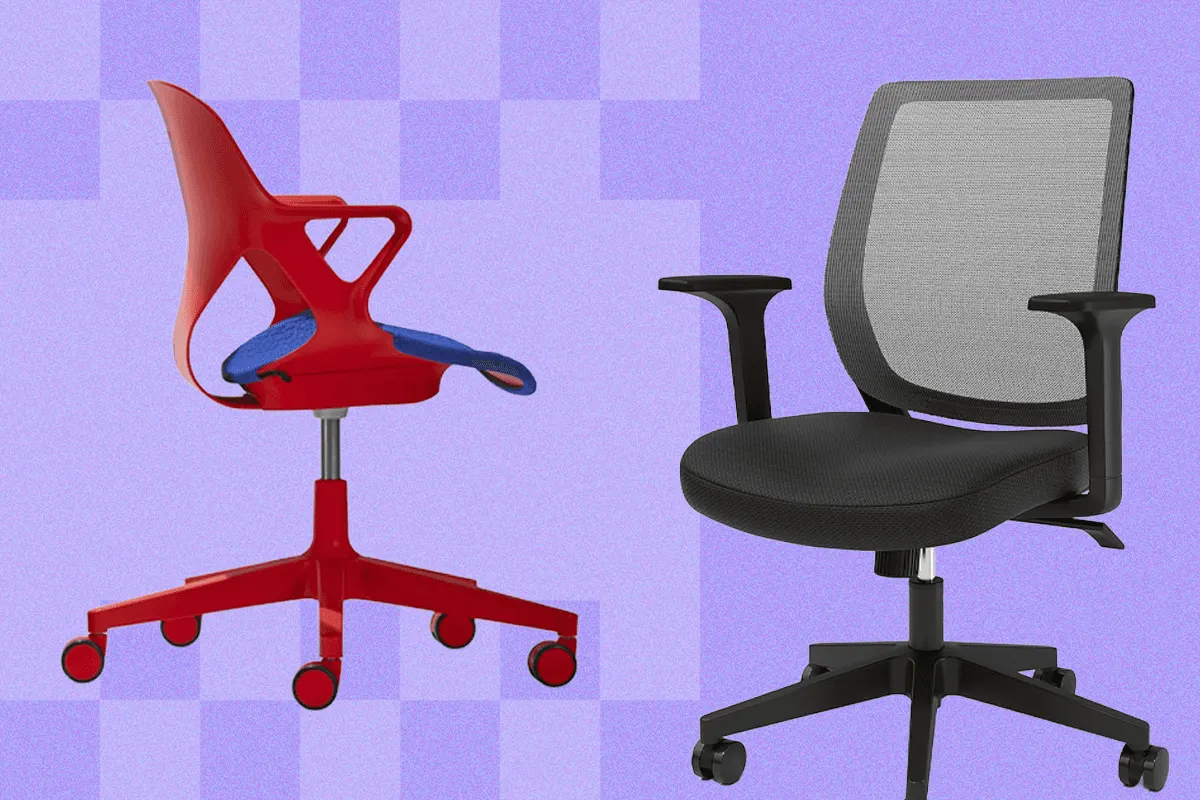
There Are Three things you don’t skimp on if you want a happy life: a good mattress , a good pair of shoes , and the best office chair you can find. Each is key to a world free of unnecessary pain. Finding the right ergonomic chair can be the difference between a satisfying and focused home office life and a squirmy day filled with cricks and small dissatisfactions.
The best desk chair is almost always an adjustable chair—one that can be tailored to your body’s unique shape and that offers enough lumbar support to avoid back problems even after long hours at the grind. Many chairs also utilize materials that can dissipate body heat, so you’re not stuck in Zoom meetings with a sweaty back. But the chair options out there can be bewildering. Luckily, the WIRED Reviews team has spent more than seven years sorting them out. WIRED Gear editor Julian Chokkattu has tested more than 60 chairs at his last tally. Reviewer Mathew Korfhage and other staffers have tried more than a dozen more, and most of our top picks have been tested by multiple people with different heights and body types.
WIRED’s favorite office chair for most people is the Branch Ergonomic Chair Pro ($499) because of its balance between value, features, comfort, and adjustability. That chair, and its lower-budget Ergonomic Chair ($369) cousin, have been tested and attested to by multiple WIRED reviewers. But we also offer chairs for every budget, from the preternaturally comfortable Steelcase Gesture ($1,510) to a $150 chair from Staples that leaves cheap Amazon brands in the dust.
We all have differing body types and needs, which is why we’ve put together a broad collection of recommendations—and why we enlist people of all sizes to keep testing our top picks for comfort and durability. Hopefully, we have a home office chair for you here.
For more home office buying guides, check out our Best Standing Desks , Best Laptop Stands , Best Home Office Gear , Best Mechanical Keyboards , and Best Webcams guides.
Updated October 2026: We tested the newly released Humanscale Freedom Ocean Headrest and added it as WIRED’s favorite reclining chair. We also added the Sihoo Doro S300 and Amseatac Crisscross Chair, streamlined our top picks, updated links and pricing throughout, and removed discontinued items.
Love WIRED? Add us as a preferred source on Google to see more of us.
The price of a good office chair often inspires actual gasps, easily cresting $1,000. This is typically justified. Most cheaper chairs reveal their shortcomings quickly and uncomfortably. Branch’s Ergonomic Chair Pro is WIRED’s top pick for most people in part because it’s available at an attainable price while still offering comfort, ergonomics, and build quality. At $499, it’s not egregiously expensive and it has a decent warranty period.
One of the main markers of a good office chair is how well it can be adjusted to fit your particular shape and size. This is where Branch’s Ergonomic Chair Pro excels. The armrests can move up and down, forward and back, and angle inward or outward. But unlike most comparable chairs, the arms of the armrests can also move in and out to accommodate wider or narrower bodies, and lock into place.
The seat depth can also be pushed out if you’re tall, or pulled in if you’re short. The Pro can lock into the upright position, or at a few different reclining angles. This seat tilt allows for a more active seating position when you’re grinding away—a vanishingly rare feature. The high-density foam cushion is decently soft, noted tester Julian Chokkattu, who appreciated how the mesh backrest was able to follow the curve of his back. The lumbar support can also be adjusted deeper or shallower. (Chokkattu and I both tend to like more aggressive lumbar support, but it can take getting used to for a lot of people.)
The stock Branch seat might be a bit short for those above 6 feet tall, but this is fixable with a $29 add-on Tall Cylinder . You can also add a headrest, though Chokkattu did not find it was needed. Other options include personalized picks on fabric, vegan leather, or leather-leather.
It’s sturdy and well-built, with a powder-coated aluminum base and casters that roll easily on hardwood. Drawbacks are few, though Chokkattu found that the recline tension knob didn’t do much in particular. —Matthew Korfhage
Steelcase’s Gesture is comfortable, no matter how you’re sitting. It’s an attractive chair, too, with several colorful upholstery options. The seat is cushy, and while some might find it thin, it feels plush compared to the even pricier Herman Miller Embody (see below). I like how you can extend the seat depth forward with a twist of a knob—super elegant, which is a good descriptor for the Gesture on the whole. The recline knob smartly offers a series of clicks to indicate the angles you can lock, and even adjusting the armrests—whether you want to move them up and down, left and right, or forward and back—is fluid without any jerky movements.
The backrest aligns nicely with my back, and you can grab the tabs to adjust the lumbar support to hit the curve of your spine. All this makes for a comfortable sitting experience, even more so with the headrest upgrade. I typically don’t care for a headrest, but I used it here more than any other chair. It sticks forward quite a bit, so I don’t need to lean my head back as far to let it rest. Assembly was easy, too; it’s simply placing the seat pan on the legs because the backrest and seat were already preassembled. The only thing to note is that since this is an all-foam chair, you may run warm, especially in the summer, unless you can crank the AC to keep your home office cool.
Another downside is that the Gesture’s upholstery may not hold up well over time, at least not as long as a seat like the Herman Miller Embody. I haven’t seen this on my test model, but our original reviewer noted it, and a friend who has owned a Gesture for several years also complained about it. — Julian Chokkattu
The Branch Ergonomic Chair was WIRED’s previous top pick for most people, before getting displaced by the much-improved adjustability and lumbar support of the Pro. But the Ergonomic Chair is still a great place to start if you’re on a tight budget. The chair assembles in minutes, with the help of the—surprisingly rare—actually intuitive instructions.
While the original Ergonomic does not offer the 14-point adjustability of the armrests on the Pro, you can still push the armrests forward and back, up and down; extend or push the seat in; or lock the recline. Adjustable lumbar support is also on offer, and the chair looks sleek—with a number of colors to choose from and an optional headrest. At its price, this is an impressive offering.
Note that the Pro’s forward tilt option is absent here, and so active sitters might find that the chair doesn’t keep your back as upright as you’d like. The OG chair also doesn’t offer a longer cylinder for taller people. But after years of testing, 6’ 4” tester Chokkattu still found the chair comfortable —as did his 5’ 1” partner. The double-woven nylon mesh backrest feels nice to lean against. The seat is made of firm, comfortable high-density foam, and doesn’t trap heat as much as many other foam seats we’ve tested.
Fair warning, though: In Chokkattu’s experience, the chair’s material can be a magnet for pet hair. If you have a cat or a dog who loves you too much, you may want to invest in a nice pet vacuum . The fabric on the front end of the seat can also pill a bit. — Matthew Korfhage
It might take you a week or two (or even a month) to get used to the Herman Miller Embody, but it’s well worth your patience. I always return to the Embody after testing other chairs, and it feels like a breath of fresh air every time. Its upright positioning supports my back well and eases lingering back pain from years of sitting in a cheap gaming chair. The seat feels rigid at first, but eventually becomes surprisingly pillowy, and the armrests stay firmly in place. It does a nice job of whisking heat away from my body, though not as well as all-mesh options. It’s also one of the most adjustable models around: You can pull out the seat, change the height and angle of the armrests, and tweak the Backfit adjustment to follow your spine’s natural curve.
Did I mention it’s pretty? I’d argue this is one of the most eye-catching designs around, especially with the rib-like pattern on the back. Not to mention the surprisingly small footprint. I know, I know, it's incredibly spendy—I bought it for roughly $1,465 back in 2020, and the price has skyrocketed since. But what’s amazing is that after more than five years, it feels good as new with barely any squeaks. Herman Miller offers a 12-year warranty that covers every part of the Embody, and the chair arrives completely assembled. Pick one of the Medley upholstery choices with the graphite base finish to see the lowest price.
Herman Miller has a “Gaming” version of the Embody , and while it looks the same, there are some minor changes. It has a copper-infused foam layer designed to accommodate a more active sitting position and wick body heat away. —Julian Chokkattu
If you have to sit at a desk for a living, I strongly urge you to save up and buy a nice, high-end chair. Buy once, cry once, right? But sometimes that’s just not possible. If you need a chair now and have a tight budget, get the Staples Dexley (6/10, WIRED Review)—the office supply company hasn’t steered me wrong yet. The Dexley is the best budget chair, miles better than most cheap chairs on Amazon. Does it have flaws? Of course. But at its frequently discounted $150 price, you can’t find much better.
The all-mesh seat is great for airflow and keeping you cool, though it is a little rough on the skin. The chair is decently adjustable, includes a headrest, and I put it together in about 15 minutes. I previously recommended the Staples Hyken here, which is still available and might be better suited for shorter people. One thing to note is that the seat may sink in a little over time, something that happened on the Hyken too; I’d be surprised if the Dexley lasts a decade, but hey, it’s less than $200. — Julian Chokkattu
An even more affordable Staples chair: The Staples Essentials Task Chair ($120) no longer offers a huge price break from the Dexley at its usual price, but it sometimes goes on sale for less than $80. With a fixed back and static armrests, it’s not as adjustable as the Dexley, but assembly is a cakewalk. Build quality is what you’d expect for a low-cost chair, but the bottom cushion offers ample support, and the mesh back feels solid but still flexible, noted WIRED contributing reviewer Henri Robbins. Just don’t expect it to adjust to your body’s shape. For a little more, the Dexley is a better budget seating experience.
The Herman Miller Aeron has long been a recommendation in this guide, with a few of my WIRED colleagues swearing by it. It’s durable, supportive, and airy; it’s also an iconic office chair that graces workspaces all over the world, updated this June with new dark olive Jasper and dark blue Nightfall color options. Last year I finally decided it was time for me to give the GOAT its due and try it for myself. Initially, I found the Aeron a little too bouncy—the proprietary Pellicle mesh is very firm—but after a few days, I didn’t mind this as much.
The levers on the Aeron are not where you’d expect. The seat height lever, for example, isn’t all the way on the underside of the chair, but on the right edge of the seat. The arm height lever is at the very back of the arm frame. It feels a little like I’m operating a spaceship with all these knobs and levers. I highly recommend watching the adjustment tutorial after setting up the chair to maximize comfort.
It comes in three sizes—A, B, and C, with C being the largest. That’s what I tested, with the Adjustable PostureFit SL, Tilt Limiter, Seat Angle, and Fully Adjustable Arms. The PostureFit SL is the lumbar support and is controlled via two knobs that push the support in or out, depending on your preferences. It worked well for me, but you can’t adjust it vertically. If the positioning doesn’t land on your back in the right spot, it could pose a problem. It may be safer to go with the Adjustable Lumbar Support instead, or try it in a retail store if possible. The Fully Adjustable Arms are convenient and don’t move around much, and while I like having the option of a forward tilt for a more active sitting position, I preferred to keep the chair on a gentle recline to keep my body moving ever so slightly.
I sat in the Aeron for close to a month, more than eight hours a day, and I found it supportive. It also regulates my body heat well, thanks to the mesh. The build quality is impeccable, and my only major gripe is that I don’t think it’s as attractive as chairs like the Anthros V2 or Herman Miller Embody (also featured in this guide), that fall in the same high-end price range. Before you buy a brand-new Aeron, there's a very good chance you can find one for significantly less at a local furniture reseller, on eBay , or Facebook Marketplace. Or you can luck out like WIRED reviewer Michael Calore, who walked away with a free Aeron after a startup in his town closed up shop. Just make sure you buy the right size for your body type: Herman Miller has a size/fit reference guide here . —Julian Chokkattu
I’m constantly reviewing office chairs, which means I get a lot of ads served my way. Anthros is one that kept cropping up in my Instagram feeds. At Herman Miller–pricing, the brand promised pain relief and an even comfier experience. Color me skeptical. But after nearly a month in the Anthros V2 (8/10 WIRED Recommends), I’m a believer.
The Anthros V2 looks nothing like most office chairs and is significantly more compact. The upper- and lower-back support are two separate pieces, and you can adjust each to accommodate your body type and achieve a natural lumbar curve. You rotate the knobs on each side to make adjustments; it initially took me a bit to get used to it, but now the chair feels natural. After you buy your seat, every customer gets a video consultation with an Anthros ergonomics therapist, who will go over the adjustments and help you get the right fit. I found this useful, as the therapist recommended a few adjustments I wouldn’t have made on my own.
Anthros’ Cloudfloat seat foam is firm but plush, much thicker than many of our other picks, and that makes it immensely comfy. Overall, I’ve felt well supported in this chair, though note that you can’t extend the seat depth. It’s shallow for my 6’4” frame, and I would’ve liked to have more support under the thighs (most people are unlikely to have this problem). The foam seat and backrest predictably don’t handle body heat well. If you’re not in a cool room, you’ll start to sweat after a long period of sitting. Then there’s the price. It costs more than a Herman Miller Embody, and Anthros has a whole page on its website explaining the price (one reason is that it’s made and assembled in the USA).
I don’t think the Anthros has quite supplanted the Embody as my favorite chair, but it's one of the rare options that has come close. It’s certainly one of the most supportive chairs I’ve sat in that’s also comfortable. If you haven’t enjoyed luxe chairs like the Embody, it’s worth giving the Anthros a try if you can stomach the price (there’s a 60-day money-back guarantee if that helps). — Julian Chokkattu
I sat on Steelcase's Karman for more than three months, and it's my new favorite all-mesh chair, especially since it has a smaller footprint than some of its peers. Mesh chairs are great for people who run warm or are generally working in hot spaces—maybe you don't want to run the window AC all day. The Karman's Intermix mesh fabric was comfy to sit on—I'm 6' 4", but my 5' 1" wife also likes it—and it didn't feel abrasive against the skin.
There's not much to adjust here, and that's by design—the company says the Karman “responds automatically to your weight.” You can raise or lower the seat and armrests, lock the recline, and adjust the armrest angle, but that's about it. It doesn't have any traditional lumbar support, though you can add it as an upgrade during checkout. I didn't need it. Even after long stretches on the chair, my back felt well-supported. Most importantly, my body never ran too hot. Steelcase has a high-back version of the Karman , which might be better suited for taller people. —Julian Chokkattu
Best affordable mesh office chair: The H2 Pro from Singaporean brand Hinomi is a more affordable, mid-priced mesh chair option priced closer to $600. It offers lots of adjustability for big and tall people especially, with 2D lumbar adjustment and even a dial to tilt the upper part of the backrest. The headrest is both sturdy and comfy, and the mesh is gentle against the skin. Adjustment to your preferred settings can require a learning curve, though.
Some sit with their feet planted firmly on the ground, as ergonomists recommend. Others sit like gremlins or house pets or a serenely meditative Buddha, every which way but straight. For these people, I humbly offer up the fully configurable Path from Humanscale—which is comfy, cool, easy to clean, and can be ordered with tiny chair arms or even no arms at all. This last option makes the Path more manageable in tight spaces, lowers the price, and lets you sit every which way.
This chair also has a tiny footprint, in every possible meaning. Measuring just 20 inches wide and 21 inches deep, the Path is one of our most compact picks (even more so than the Zeph, below). But also, Humanscale is one of the more forward-thinking office furniture companies when it comes to sustainable design. And like Humanscale's Freedom Headrest , this Path earns high marks for its minimal ecological impact. About 10 percent of each chair's materials are recycled, mostly plastic bottles and ocean plastics. Textile options include an Eco Knit material made of 100 percent post-consumer recycled polyester.
The chair is easy to assemble, averred WIRED reviewer Michael Calore, arriving in a minimal cardboard box with all three pieces (legs, seat, and back) wrapped in compostable bags. But most importantly, Calore noted, the Path is just plain comfortable. The cylinder holding up the seat is smoothly supportive with a patented “gravity mechanism” that lifts the seat as you recline for a more ergonomic experience. — Matthew Korfhage
Another office chair good for small spaces: The Herman Miller Sayl ($1,225) is another good option for short people or anyone hunting for a chair for small spaces. Reviewer Julian Chokkattu quite liked sitting on it, despite being 6' 4". The shorter backrest did not dig into his shoulders, Chokkattu noted, and the mesh net-like design is flexible, so it contoured to his back. The seat padding is medium-firm, and can be adjusted in various ways to make it work for your body, though you'll need to follow this guide to figure out all the levers and knobs under the chair. Lumbar support can be added for a small price bump.
The right chair can only go so far. Your sitting habits and posture matter too. We've rounded up several tips on how to set up your desk properly here , and how to avoid tech neck , but here are a few highlights.
Sitting for long stretches during a day is not good for your health , no matter what chair you use. It increases the risk of type 2 diabetes, stroke, and heart disease . The best thing you can do is get up and move every half hour. If you can, a 40-minute walk per day can, according to a recent study , make a big difference in countering some effects of a sedentary lifestyle. You probably don't need to bother with an active chair . Home office users should consider a standing desk that lets you swap between standing and sitting work positions during the day. A smartwatch can help too. Most have movement reminders that encourage you to stretch your legs. If you're dealing with back pain, consult your physician first.
Make sure your chair's armrests are adjustable. Your palms should be elevated over your desk, which should be at elbow level, and your wrists should be straight. If the bottom of your palm is resting on the desk or wrist rest, there's a chance you're putting too much pressure on your nerves, which could lead to issues like carpal tunnel syndrome. Talk to your physician if you're feeling any kind of pain. A gaming mouse, often more ergonomic than a standard mouse, might be helpful ; just make sure to find one that fits your palm size .
When you look forward, your eyes should align with the top of your monitor or laptop. That might mean finding a chair that can adjust up and down, elevating your laptop with a stand , or raising the height of your monitor. This puts less pressure on your neck and spine—you shouldn't be craning your neck up or down .
A good rule of thumb is that the more adjustable a chair is, the better. This gives you the possibility to mold it to your body shape, which hopefully makes it a comfier and more supportive seat. Here's what you should be able to adjust on a chair.
Armrests: Most chairs let you move the armrests side to side, up and down, forward and back. It's even nicer when you're able to lock the armrest into place so that they don't slide around as your elbows rest on them. The armrest should naturally allow your palms to slightly hover over the desk. You'll often see descriptors like “4D” and “5D" adjustable armrests, which denote how many directions you can adjust them.
Seat height: It's worth checking a chair's maximum and minimum height before you buy because they might not work for your current desk (unless you have a standing desk where you can adjust the height). This is usually controlled with a pneumatic lift lever under the chair—pull the lever and get off the seat to let the chair go up, then sit on it and pull the lever to bring it down to your preference. Your feet should be planted on the floor at a 90- or 100-degree angle. If your chair arrives and it doesn't get as high as you'd like, don't worry, there's a very simple fix. Some office chair brands offer “tall cylinders" for not a lot of money , and if not, you can usually find third-party options on retailers like Amazon (make sure you buy for your specific chair!). Simply swap your existing cylinder with the tall version, and you'll have a greater height range to work with. You may be able to choose this option before checking out, or reach out to the company to see if they can swap it for you.
Seat depth: Seat depth is important for taller folks. There is usually a mechanism that lets you pull the seat out so that your thighs get the proper support. There should be one to two inches between the front of the seat and the back of your knees. Taller people with longer legs may not get the best support if they can't adjust the seat depth.
Seat tilt: This isn't as common as the above adjustments, but tilting the seat up or down may help posture and prevent back pain, though it can take some getting used to.
Lumbar support: Most office chairs offer lumbar support , which can look like a separate piece attached to the backrest that can slide up and down or back and forth. This piece supports your lower back (the lumbar region), specifically maintaining the curve of the spine to maintain good posture as you sit and, ideally, warding off back pain. Check your chair manufacturer's assembly instructions to learn how to adjust the lumbar support, and place the support on the curve of your lower back. What I like to do is run my hand along my spine until I reach the natural dip, then I try to make sure the lumbar support sits at that exact location. Some chairs also let you adjust the depth of the lumbar support, pushing it further inward or outward. Make sure it feels natur…