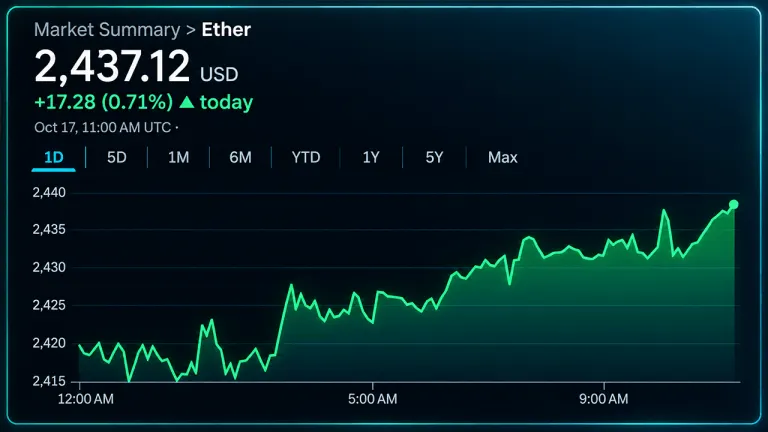
Ethereum’s price has spent the week bouncing between $2,324 and $2,575, but beneath the price swings, derivatives traders are carrying $30.59 billion in futures exposure while options bulls command nearly 62% of outstanding positions. The catch is that futures positions are contracting, short-term liquidations favor longs, and major options exchanges disagree on where ethereum’s fiat value might cause the most financial pain.
Ethereum’s futures market isn’t exactly running short of ammunition. Current Coinglass figures show 12.63 million ETH in outstanding futures contracts, valued at $30.59 billion, even after aggregate open interest slipped 0.42% over 24 hours. Open interest measures contracts that remain active rather than completed trades, making it a useful gauge of how much speculative money is still in the game.
The centralized exchange (CEX) Binance leads the exchange rankings with $8.73 billion in ethereum futures open interest (OI), representing 28.55% of the total. MEXC follows with $3.25 billion, narrowly ahead of CME’s $3.24 billion. The perps decentralized exchange (DEX) Hyperliquid carries $2.61 billion, Bybit holds $2.15 billion, and Bitget accounts for another $2 billion. That’s a tidy sum spread across traditional and crypto-native trading venues.
The exchange-level action tells a less comfortable story. MEXC’s ether OI climbed 6.49% over 24 hours, while Bitget gained 1.22%. Meanwhile, Bitunix shed 11.27%, BingX declined 7.57%, and Hyperliquid slipped 1.70%. CME recorded a 1.11% contraction, suggesting traders weren’t uniformly eager to increase exposure.
Liquidations delivered another jolt. Over 24 hours, ethereum registered 3,222 long liquidations against 2,181 shorts during Friday’s session. The 12-hour figures were even more lopsided, with 2,651 longs versus 876 shorts. Funding rates, however, remained predominantly positive, with Cryptoquant’s latest reading near 0.0053, indicating that leveraged bullish positions continued paying shorts.
Options traders are singing a different tune. Ethereum ‘s outstanding call options total 1.59 million ETH, compared with 983,689 ETH in puts, giving calls a 61.75% share. Calls generally benefit from rising prices, while puts provide downside exposure or protection. Yet 24-hour trading volume was nearly evenly divided, with 414,521 ETH in calls against 420,513 ETH in puts.
The largest individual positions reveal where traders have planted their flags. Deribit’s Dec. 25 $3,200 call leads with 69,667 ETH, followed by its $2,200 call with 51,016 ETH. The Oct. 30 $2,600 call holds another 38,043 ETH. These contracts reflect substantial interest in different price outcomes, although outstanding calls alone cannot establish whether their holders are making outright bullish bets.
CME’s options market offers another interesting wrinkle. Cryptoquant’s expiration-stacked data shows outstanding contracts falling considerably from earlier 2026 levels, when the series briefly exceeded 500,000 ETH. By October, the total appears closer to 50,000 ETH, with remaining exposure distributed across several expiration windows rather than concentrated in one giant maturity.
CME’s position-stacked metrics also show puts retaining the larger share of outstanding dollar exposure. Combined options positions have fallen from readings exceeding $70 million during late 2025 to roughly $10 million in October. The contraction suggests a smaller options footprint on CME , even as broader exchange-traded ethereum derivatives maintain substantial exposure.
The max pain calculations add another twist. Max pain is the theoretical settlement price at which outstanding options collectively produce the smallest payout to holders. For the Oct. 30 expiration, Deribit and Binance point toward approximately $2,500, while OKX sits higher near $2,650. For Dec. 25, Deribit drops toward $2,200, OKX approaches $2,300, and Binance remains near $2,500.
These levels aren’t price forecasts, and the exchanges’ differences reflect their respective options positions. Still, the numbers expose an intriguing contradiction. Ethereum’s options market favors calls, futures traders retain billions in exposure, and funding remains positive, yet liquidations keep clobbering leveraged longs. Bulls may hold the numerical advantage in options, but the derivatives market hasn’t handed them the keys to the kingdom.
Bitmex co-founder Arthur Hayes says the artificial intelligence boom is burning cash on a government backstop, and that the bigger…