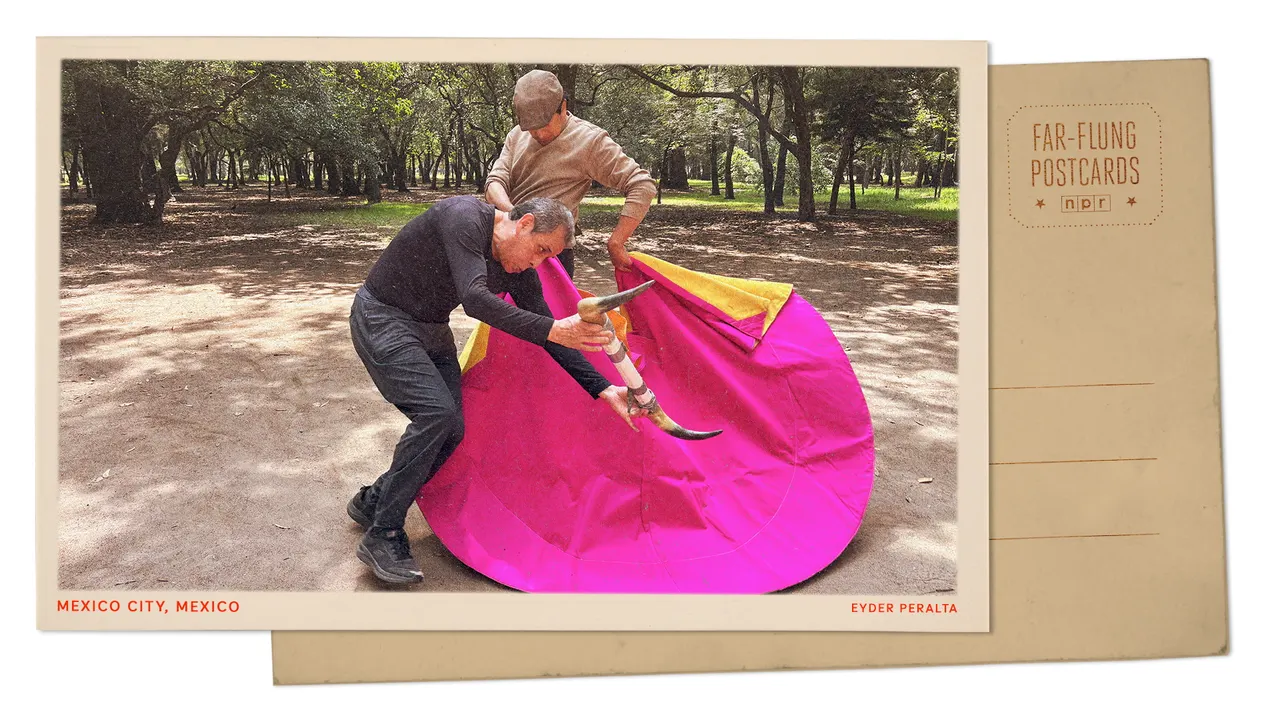
They practice in the middle of Mexico City's big urban park. With a pair of real horns, one of them plays the bull by gliding toward the fuchsia bullfighting cape. They're practicing to kill, but as the sunlight filters through the trees and the bullfighter dodges with grace, his hips to one side, his arms perfectly perpendicular, it looks incongruently beautiful.
"It's the ballet of death," José Luis Herros explains. But the movement from the bull looks too slow, too graceful, I tell him.
"That's the way bulls move," he says. When their head is down and it's ready to gore you with its horns, he explains, it comes at you slowly.
"The whole point of bullfighting is to face fear and death with the intelligence that we supposedly have," he says. "The bull has two daggers, we have this piece of cloth."
The people who gather here are real bullfighters. Mexico City has banned killing bulls so they travel outside the capital city for their sport.
As soon as I showed interest, they showed me the scars from moments that took them to the edge of death. "One bull tore my chest in half," Luis Conrado (in the sweater) told me. "But I kept fighting and I cut off an ear."
Again, I thought, the beauty of this scene was incongruous with the frank talk of death.
NPR does not offer or accept money for coverage or interviews. Anyone who makes such an offer or request is not an NPR employee and does not represent NPR.