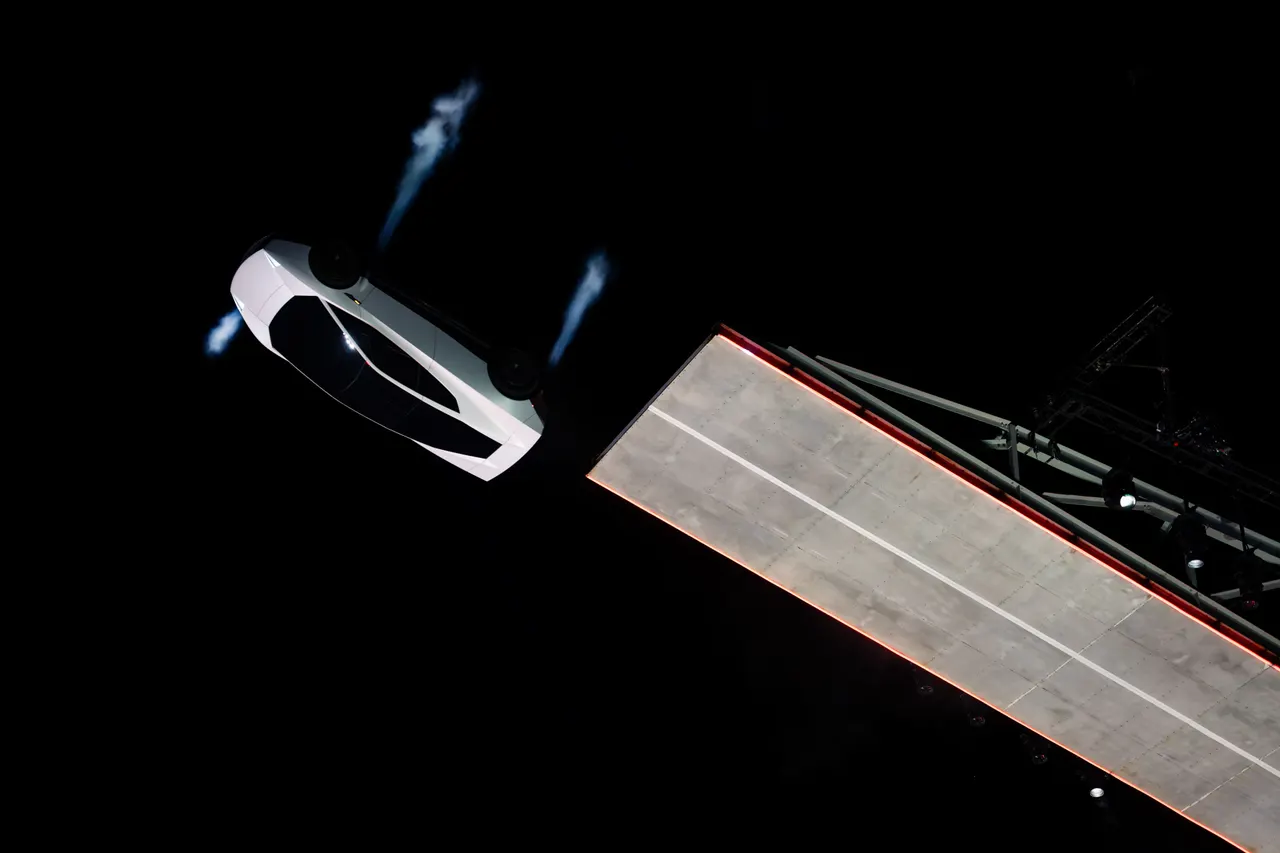
We’ve been promised flying cars for decades. We finally have one. Well, sort of.
Last week, Elon Musk revealed Tesla’s long-delayed Roadster 2 with a few bells and whistles. The car flies—but not for very long—and the prototype also did a few other things normal cars can’t , like driving up a vertical wall and jumping over Tesla’s entire lineup of vehicles.
This raises two questions: Should we let humans drive up walls and into the air? Given their trouble navigating two-dimensional roads, this seems like an obvious no. But that’s one for lawyers and the Federal Aviation Administration to figure out. The other question is, how did the Roadster 2 prototype do this stuff? We can answer that ourselves, with physics.
Let’s start with how the car drove up a circular ramp and then stayed glued to it Spider-Man–style, completely upside down. I don't think you should ever do this, but this feature of the Roadster 2 can actually improve performance on normal roads. It has to do with friction .
When two surfaces interact—like rubber tires and a road—there can be a force that prevents the surfaces from sliding relative to one another. This interaction is called static friction. We have a simple model for this static friction force where the magnitude ( F f ) depends on how hard the two surfaces are pushed together ( F N ) and the two types of surfaces ( μ ).
The force pushing the surfaces together is often called the “normal” force, since it's perpendicular to both surfaces. The coefficient of static friction ( μ ) describes the types of materials interacting. The practical maximum coefficient of friction is 1, and for rubber on asphalt, the value is somewhere around 0.6. What about that ≤ sign? This is because static friction is a “force of constraint.” It applies the force needed to prevent sliding—up to some maximum value.
Suppose a mere mortal car tries to drive up an incline. Here's a force diagram showing the three important forces: friction, normal force, and gravity (the product of mass and the gravitational field).
As the angle ( θ ) of the incline increases, the gravitational force ( mg ) has less of a component in the direction perpendicular to the surface. This means the normal force ( F N ) also decreases, as does the maximum frictional force. If this frictional force is less than the component of the gravitational force pulling down the incline, the car will slip. With a coefficient of 0.6, this maximum angle is about 31 degrees. That's not vertical. It's not even close to vertical. Even with a coefficient of friction at 0.9, you still only get to an incline of 42 degrees.
So how can a car drive up a vertical wall? The answer is to increase the normal force—and, by extension, the frictional force. For a vertical wall, this friction force must be equal to the gravitational force to prevent the car from slipping.
Here's where the Roadster 2 does its first trick. It uses fans to blow air out from under the car. With some side flaps, this lowers the air pressure under the car, akin to how a vacuum cleaner works.
Just for fun, let's estimate the pressure under the Roadster 2 that you would need for it to stick to a wall. The company says the car has a target weight of 1,700 kilograms. We also need to know the contact area. Let’s ballpark it at around 2 square meters. Remember that F = P × A , where P is the pressure and A is the area. But this is really a pressure difference with the external atmospheric pressure at about 10 5 newtons per square meter. Cranking the numbers gives a bottom pressure of 86 percent of atmospheric pressure. That seems very plausible. Of course, since the seal around the bottom isn't perfect, the fans will need to continue pulling out.
The upside-down Roadster 2 makes for a compelling sales pitch, but the suction actually has a strong use case when it’s driving right side up. Frictional force is the thing that makes a car accelerate. More frictional force, better performance . Pushing the car down means you can accelerate faster and brake faster and make sharper turns. ( Performance automakers have harnessed this principle for decades, though not to the degree of Tesla’s new prototype.)
The Roadster 2 also boasts an acceleration of 0 to 60 mph in less than a second. For a traditional car, this is impossible. Since a normal car uses the frictional force between the tires and road to accelerate, it's limited by the coefficient of friction. Using a coefficient of friction at 0.6 (reasonable), the best you can do is 0 to 60 mph in 4.56 seconds. Yes, you can get better tires and you can also increase the frictional force once the car moves faster and interacts with the air (pushing it down)—but those improvements still won’t get you to 60 mph in a second.
The Roadster 2 relies on another form of force: compressed air shooting out the back. This is how rockets work. Since most of us don’t have rockets handy, consider the simple experiment of a toy car propelled by an inflated balloon.
Once the balloon is released, the stretched rubber acts as a force that pushes the air out of the balloon and through an attached tube. But since this air has mass, it will take a force to accelerate it from rest to its exhaust velocity. Here's the cool thing about forces—they are an interaction between two things (like the balloon and the air). That means that when the balloon’s walls push on the air, the air pushes back with an equal force in the opposite direction—an example of Newton’s third law. This push-back force on the balloon is what makes the toy car accelerate. Instead of a wheezing balloon, the Roadster 2 relies on a tank of compressed air.
Now, we get to the flying car part. The Roadster 2 uses the same compressed-air method to push up on the car and get it off the ground. That’s stretching the limits of the term “flying,” especially because there's only a few seconds of thrust that it can get from the tank before the pressure drops. With a lower tank pressure, the air comes out with a lower velocity and less thrust. If I was going to have a flying car, I would hope it could at least fly for 10 minutes of air time.
There's a second issue—acceleration. Since the rockets only last for a short time, they need to apply a large force to get a change in velocity and get the car to leapfrog over a truck or some other obstacle. But with a large force, you also get a large acceleration, and large accelerations are generally bad for humans. We can estimate this acceleration using video analysis . I'm going to use Tracker Video Analysis to mark the location of the car in each frame as it jumps over a Tesla Semi truck. Because we know the truck is about 4 meters tall, we can get the position of the car as a function of time. Here is the vertical position of the Roadster 2 during this jump.
Right there at the beginning of the motion, the vertical velocity of the car is zero, and then it accelerates upward. If we assume constant acceleration during this jump, then the position-time data should be in the shape of a parabola. Fitting a quadratic function to this data gives the acceleration. For this particular motion, I get a rough estimate of about 98 meters per second squared of vertical acceleration. That's right around 10 g’s for humans. That’s just an estimate, of course. Humans can survive that level of force for a short period, but it wouldn’t be pleasant, and it still comes with risks. Maybe that's the reason this particular demo had a robot behind the wheel.