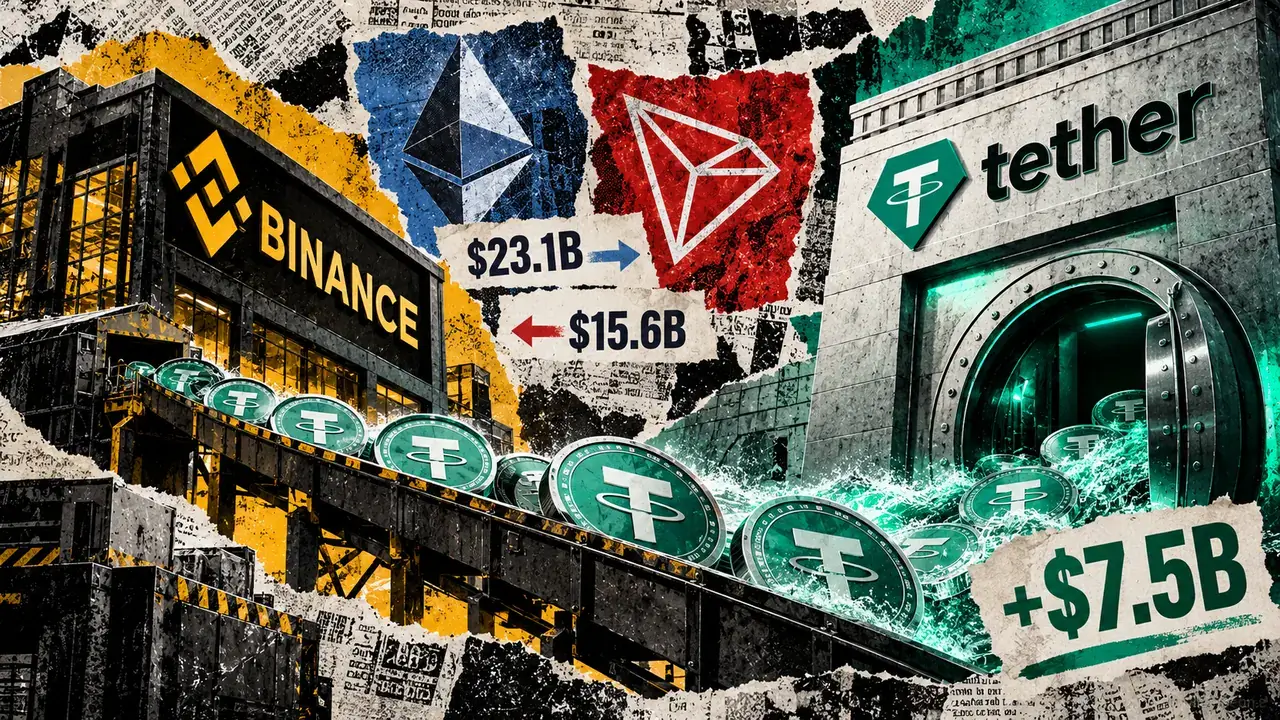
Binance's stablecoin flows with Tether have reversed by nearly $14 billion, raising concerns about declining liquidity at the world's largest crypto exchange.
An Oct. 22 investigation by blockchain analytics firm Bitquery found that Binance-linked wallets transferred $23.1 billion in USDT to Tether during 2026 while receiving $15.6 billion, leaving a $7.5 billion net imbalance toward the issuer. That compares with a $6.4 billion net inflow during all of 2025.
The reversal coincides with a decline in Binance's tracked Ethereum stablecoin holdings from $43.9 billion in April to $38.8 billion on Oct. 22. The findings raise questions about how much buying power remains available on the exchange as Bitcoin struggles to regain momentum around $80,000.
Binance accumulated substantial stablecoin holdings throughout 2025, with its identified Ethereum wallets reaching a record $45.6 billion in November, more than triple their October 2024 balance.
That accumulation has since unwound. Stablecoin holdings slipped to $39.5 billion by July before falling to their lowest level since September 2025 this month, suggesting a decline spread over several months rather than a single withdrawal event.
The movement was most pronounced in Binance's largest cold wallet, which held about $28 billion in USDT at its peak but carried$16 billion on Oct. 22.
However, two other cold wallets accumulated a combined $6.2 billion over the same period. Bitquery accounted for those internal transfers when calculating the exchange's aggregate holdings, separating movements between Binance-controlled addresses from the broader reduction.
The transactions with Tether offer another perspective on that decline.
During all of 2025, Binance sent $16.6 billion in USDT to Tether's treasury . The corresponding transfers during the first ten months of 2026 have already exceeded that total, reflecting a substantial increase in tokens returned to the issuer.
Most of this year's outgoing activity originated on Ethereum, which accounted for $19.6 billion of the transfers. Incoming USDT followed a different route, with $13.6 billion arriving on Tron .
The change suggests that part of Binance's treasury activity may involve moving stablecoins between blockchain networks.
Under Tether's issuance procedures , exchanges can return USDT on one network and receive equivalent tokens on another without reducing the overall supply. The issuer can also retain returned tokens in its treasury before reissuing or destroying them.
Those arrangements complicate Bitquery's interpretation of the transfers as evidence of capital leaving cryptocurrency markets. Although the transactions show a substantial shift toward Tether, they do not independently identify how much USDT was redeemed for dollars versus moved between networks.
This distinction has consequences for cryptocurrency demand.
Stablecoins provide much of the dollar-linked purchasing power used to trade Bitcoin and other digital assets. Actual redemptions that remove USDT from circulation can reduce that pool of capital, particularly if new issuance fails to replace the withdrawn funds.
However, Binance's declining wallet balances and its transactions with Tether measure different aspects of exchange activity. The former tracks USDT and USDC held in identified Ethereum addresses, while the latter captures USDT moving between the exchange and its issuer across Ethereum and Tron.
Neither measure establishes how much customer capital has permanently exited the market.
Bitcoin's recent weakness around $80,000 heightens the concern, as renewed buying demand could help determine whether the cryptocurrency stabilizes or extends its losses.
Further declines in Binance's holdings, particularly alongside a sustained contraction in circulating USDT supply, would strengthen the case that stablecoin purchasing power is weakening.
A recovery in deposits or fresh issuance would instead indicate that liquidity is returning, potentially restoring a source of demand that helped support cryptocurrency trading during Binance's earlier accumulation period.
Oluwapelumi values Bitcoin's potential. He imparts insights on a range of topics like DeFi, hacks, mining and culture, underlining transformative power.