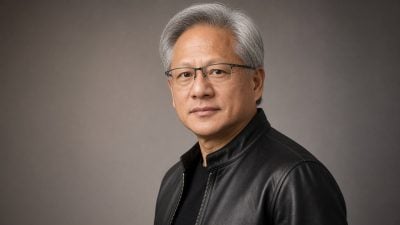
During a Taiwan visit tied to Computex 2026, the Nvidia CEO argued that selling technology builds more security than blocking it
Nvidia CEO Jensen Huang has a message for Washington: the best defense might be a good sales team.
In a 90-minute video released by podcaster Lex Fridman on October 13, 2026, Huang argued that US export controls on advanced computing should be “extremely selective” . He warned that broad restrictions could backfire on the country they are meant to protect.
The conversation took place during Huang’s visit to Taiwan connected to Computex 2026. That setting matters. Few places on Earth are more central to the export control debate than the island that manufactures most of the world’s cutting-edge chips.
Huang’s core pitch rests on a concept he calls a technology and economic “flywheel.” Global sales generate the money that pays for innovation. That innovation keeps American technology ahead, which drives more global sales.
Broad export controls, in Huang’s telling, jam a stick into those spokes. If rival nations cannot buy American computing technology, they have a strong incentive to build their own. Once they do, the US loses twice: it forfeits the sales revenue that fuels its own research, and it hands rivals the motivation to develop domestic capabilities that could eventually compete head to head.
Huang framed this as a contrast between two philosophies. Traditional export controls are built on denial: keep the good stuff away from the wrong people. Huang instead described a prosperity-driven approach to security, one that treats strong global partnerships and economic strength as protective assets in their own right.
He did not argue for zero controls. The phrase “extremely selective” leaves room for restrictions. It just suggests those restrictions should be narrow and targeted rather than sweeping.
Daily. Free. Join 34,000+ readers across crypto, finance, and policy.
Much of the conversation reached back into Nvidia’s history with TSMC, the Taiwanese chipmaker that manufactures its processors. That relationship began in the mid-1990s, after Huang made a cold call to the company. According to Huang’s account, TSMC founder Morris Chang stressed that the two companies should treat their arrangement as a partnership rather than a set of transactional terms.
Taiwan currently holds more than 90% of the market for advanced semiconductor manufacturing, meaning chips built on sub-10nm process nodes. Those are the tiny, densely packed chips that power modern AI systems. That concentration positions the island as essential to scaling what Huang and others describe as a future trillion-dollar AI compute market.
Huang also spoke about Taiwan’s cultural and historical role in building its global semiconductor leadership. His comments suggested he sees the island’s position as something cultivated over generations, not a lucky accident.
This visit was not a one-off. Huang has made multiple trips to Taiwan in 2026, many tied to Nvidia’s plans for a new headquarters on the island. The company is looking to establish a presence in the Beitou-Shilin Technology Park.
Huang’s position sits at the intersection of two forces that do not always point the same direction: national security policy and corporate revenue. The CEO of a company that sells advanced chips is arguing for fewer restrictions on selling advanced chips.
Restrictions that push rivals to develop homegrown alternatives could, over time, erode the very technological lead they were designed to protect. Policymakers have to weigh short-term denial against long-term competitive dynamics.
The broader question Huang raises is philosophical as much as economic. Does a country stay ahead by keeping its best tools to itself, or by making sure everyone else depends on them? Washington has largely leaned toward the first answer. Huang is making a public, 90-minute case for the second.