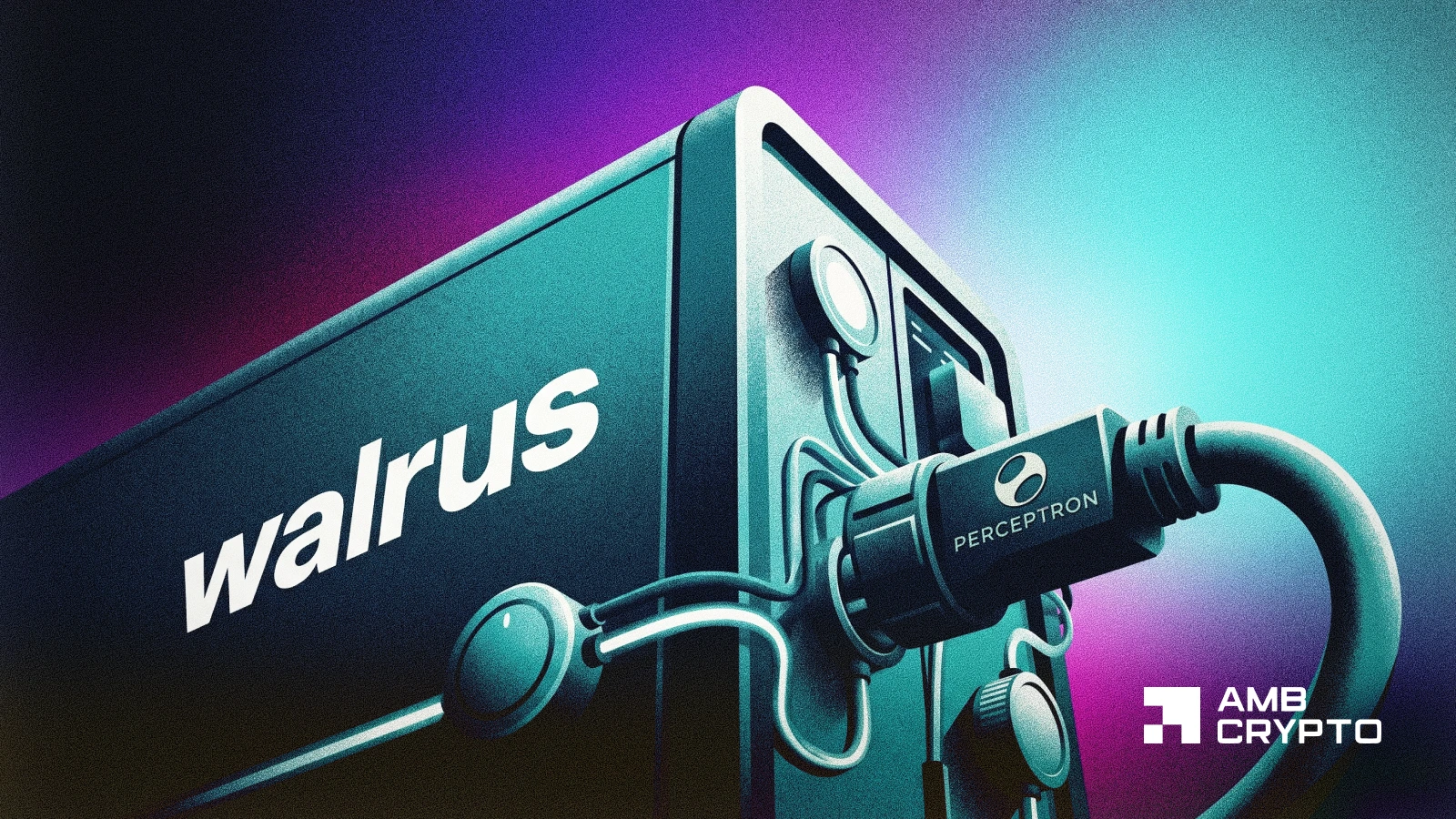
Perceptron , the distributed intelligence infrastructure powering over 800,000 global contributor nodes , is in the news today after announcing its strategic migration to Walrus , the data platform built for the demands of AI. This integration marks a key shift in how datasets are stored, verified, and distributed, replacing legacy centralized storage with a system that offers cryptographic proof of data integrity and immutable history.
By adopting Walrus as its primary storage layer, Perceptron wants to eliminate the friction of egress fees and opaque pricing models associated with traditional cloud providers. The move will also ensure that every dataset generated by Perceptron’s network, from real-time market signals to annotated training data, carries a verifiable identifier.
This would enables enterprise buyers such as hedge funds and AI labs to cryptographically verify the origin and integrity of the data they consume — a requirement increasingly mandated by compliance frameworks in finance and other regulated industries.
According to Peter Anthony, Co-founder and CEO of Perceptron ,
The structural mismatch between the decentralized acquisition layer and centralized storage has long been a bottleneck for the industry. The decentralized brain that’s been connected to a centralized memory has left clients guessing. Not anymore. With Walrus, the data is signed, and our clients can now verify the chain of custody themselves. This shift from trust to verify yourself is exactly what the market has been waiting for.
The integration serves as the foundation for Perceptron’s upcoming Data Questing Platform, which will enable contributors to actively annotate and structure data. With Walrus handling the backend, Perceptron can scale permissioned access to high-value and real-time data products while maintaining total network decentralization.
This architecture will also ensure that data remains resilient and available, encoded across a decentralized network of storage nodes so that it stays accessible even if a portion of the network goes offline.
According to Kimberly Logan, Head of Product at Walrus Foundation,
Data verifiability is becoming one of the newest competitive advantages for businesses serving enterprise customers. Hedge funds, quantitative researchers, and AI companies depend on real-time intelligence and they increasingly need to prove the integrity of that data. The next frontier of AI will be won on data, and as agentic systems demand proof over trust, the verifiability Walrus brings becomes essential.
The migration will also unlocks new economic efficiencies for Perceptron’s global network of contributors. Under the previous centralized model, data accumulation often led to compounding storage costs and steep fees whenever enterprise clients retrieved datasets. These hidden costs had created structural drag on the network’s scalability and limited the types of high-frequency, real-time data products that could be offered profitably.
By leveraging Walrus’s decentralized storage, Perceptron will decouple data availability from cloud pricing dynamics. The result would be a more sustainable cost structure that allows the network to scale its 800,000 nodes without passing unpredictable expenses onto buyers or contributors.
Perceptron users will soon be able to annotate images, label complex datasets, and submit structured inputs directly to the network, with every contribution immutably recorded on Walrus. This evolution from passive observation to active intelligence creation will significantly expand the diversity and depth of available data while ensuring that every piece of human- or machine-generated insight carries a verifiable stamp of authenticity.
As the boundary between physical reality and digital intelligence comes together, the combination of Perceptron’s distributed sensing and Walrus’s verifiable storage will create a robust foundation for the next generation of trustworthy AI applications.