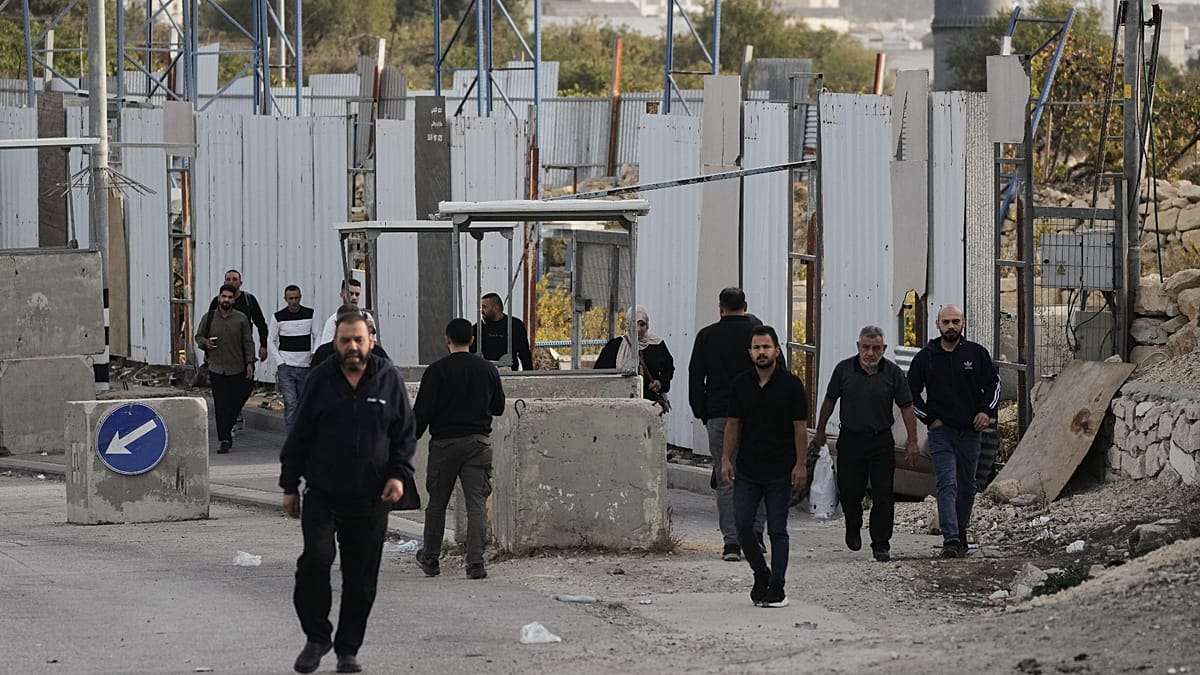
Israeli forces pushed into the West Bank city of Hebron on Saturday and displaced up to 250 families, some in the middle of the night, vowing a heavy price over a deadly attack on two soldiers.
Prime Minister Benjamin Netanyahu said he was planning an operation on a scale not seen since Israel first occupied the West Bank in 1967. The lockdown comes after Palestinian militants killed two Israeli soldiers on Friday at a checkpoint near Hebron, a flashpoint city in which hardline Israeli settlers live surrounded by local Palestinians.
The operation is taking place just days before Israel is set to hold elections on Tuesday, in which Netanyahu is expected to face a tight race with the opposition bloc led by former military chief Gadi Eisenkot.
In the neighbourhood of Ein Dir Baha nestled between two hills, buildings were marked by X's showing they had been cleared of people.
The streets in the area were deserted of people and cars other than Israeli military vehicles. Around one-third of Hebron has been targeted, local Governor Khaled Dudin told news agency AFP.
"They started in the neighbourhood from which the people who carried out the attack came, but there is no guarantee that the operation will not expand," he said. "This amounts to collective punishment being imposed on civilians who have nothing at all to do with this," he said.
The governor said 150 families had been affected, while the mayor of Hebron, Youssef al-Jaabari, and local activist Issa Amro put the figure at 250.
"We will find them shelter and provide these people with all the help they need," the mayor told AFP.
The Israeli military said it was "conducting precise, targeted and thorough searches" focused on the area of the two gunmen, who were both killed in the gunfight.
It said the operation would last several days, in line with similar army actions after previous attacks.
Prime Minister Binjamin Netanjahu's far-right national security advisor, Itamar Ben Gvir, has called on Israel to dismantle the Palestinian Authority, the semi-autonomous body that governs parts of the West Bank in cooperation with Israel under 1990s peace accords.
Asked if he agreed on destroying the Palestinian Authority, Netanyahu, Israel's longest-serving prime minister, boasted that he has rejected pressure from three US presidents to work to establish a Palestinian state.
Taxis piled up behind gates controlled by Israel's military outside Hebron, waiting for Palestinians who are forced to cross on foot. All gates leading in and out of the city were closed to vehicles, according to Basma Radio, a Telegram channel Palestinians use to monitor checkpoints and road closures.
Israel's army didn't respond to questions about the operation. On Friday, it said that in response to the killing of two soldiers and wounding of others, its forces had begun “conducting precise, targeted and thorough searches” in the area of Hebron from which the two gunmen had operated.
Rights group Yesh Din reported 672 incidents of settler violence over the past 26 days, nearly half related to the olive harvest, an annual event with cultural resonance to Palestinians that extremist settlers have sought to stop.
Polls show Netanyahu neck and neck with an opposition bloc led by Gadi Eisenkot, a centre-right former military chief who also opposes a Palestinian state but has promised to crack down on settler violence.