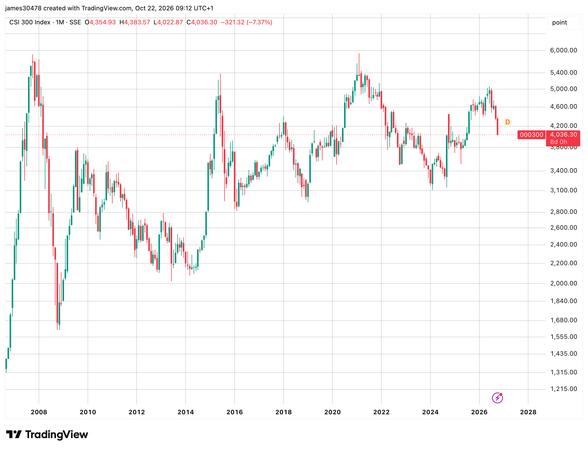
Asian stocks tumbled on Thursday, with Chinese equities entering a bear market as technology shares sank and rising oil prices compounded investor concerns.
The CSI 300, which tracks the 300 largest stocks traded in Shenzhen and Shanghai, slid 2%, taking the decline from June’s peak to 20%. Other regional benchmarks followed suit. Japan’s Nikkei 225 fell around 3%, South Korea’s Kospi dropped 3.5%, Taiwan’s benchmark lost 2% and Hong Kong’s Hang Seng declined 3%.
Chinese technology shares traded in Hong Kong faced their worst session since President Donald Trump’s April 2025 “Liberation Day” tariff announcement, according to Bloomberg’s David Ingles .
According to Ingles, the technology benchmark has fallen more than 40% from its peak, almost erasing gains following Beijing’s Sept. 24 stimulus package, with forward valuations compressed to roughly 13 times earnings.
Mixed third-quarter earnings reports from U.S. companies added to the uncertainty surrounding artificial intelligence investment. Tesla TSLA fell around 3% after the market closed after cutting its capital-spending forecast, while Meta Platforms META raised the lower end of its spending guidance.
Bitcoin BTC $84,459.46 gave up its advance above $84,000, retreating toward $82,000. Gold fell more than 1% to below $4,100 an ounce, while silver dropped over 3.5% to around $55. Nasdaq 100 index futures declined almost 2%.
The Cboe Volatility Index, or VIX, jumped 10% to around 18, roughly 30% above September’s low. Meanwhile, WTI crude topped $100 a barrel and Brent crude climbed above $112 to the highest levels since May.
The equity selloff persisted despite easing Treasury yields, which would tend to make stock-market investments more attractive. The U.S. 10-year yield stood near 5.077%, below its recent peak around 5.4%.
Diversified RWA stablecoins sustain 5-7% yield from real credit as crypto funding compresses to ~4%. GENIUS pushes yield off-chain; TAM grows to $4B in 3 years.