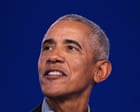
Speaking at live UK event, former US president expresses hope rooted in the past and discusses the modern challenges to democracy
Barack Obama cited the “wonderful” story of how Manchester cotton workers stood in solidarity with enslaved African Americans as an inspiration for our times in a live appearance in the city.
Tens of thousands of people packed Co-op Live in the city on Thursday for An Evening With Barack Obama , where the former US president was interviewed by the writer and broadcaster Afua Hirsch.
Obama closed the 90-minute event, punctuated by cheers, whoops, laughter and applause from the audience, by discussing the work of the Obama Presidential Center, a museum, library and education project in Chicago, and that of his foundation – committed to challenging economic inequality, the climate crisis, education and health, with programmes for women and girls, global emerging leaders, and journalists in oppressive regimes.
He spoke of the hope he took from the younger people he worked with, and from the Lancashire cotton famine, in which workers from Manchester and surrounding towns supported Abraham Lincoln’s blockade of cotton from enslaving Confederate states.
Obama said the centre was about reminding people what was possible. “I was reminded being here at Manchester of just this wonderful story of the cotton workers here at Manchester. During the American civil war in 1862 at a time when their livelihoods depended on cotton and the union had set up a barricade and prevented cotton from leaving the South as part of the civil war effort.
“And yeah, the business people and manufacturers, and I think even the Guardian editorialised ‘don’t mess with that, you know, this is our lifeblood’ and over at the Free Trade Hall, a bunch of British working workers who are hungry and not sure whether they’re gonna be able to hold things together, sit there and they meet, and they collectively say, we are going to stand with those who are fighting for freedom, even if it’s going to cost us.
“And so you hear a story like that. And they write a letter to Lincoln and he writes back. And commends them for a historic expression of Christian humility and charity, and grace. And so you then say to yourself, if they could do it, why can’t we?
“There was no guarantee that they were gonna benefit in any way from it, but somehow, their life was better for that. Even in the midst of hardship. And I think if we could tell each other those stories, and pass those to our children and are our grandchildren. We’ll get through these times too.”
The Guardian’s Cotton Capital series launched in 2023 to explore its founders’ links to the cotton trade and transatlantic enslavement, including how the newspaper covered the subject at the time.
Hirsch spoke of the huge impact Obama’s 2008 A More Perfect Union speech had had, including for her as a “a black British person of mixed heritage”.
Asked to share the ways his identity is reflected in his politics and leadership, Obama said it did so in ways “particular to the United States”, and ways that were “more universal”.
He added: “Race is this faultline of so much of American history … our union made a series of compromises, including, essentially, tacitly ratifying slavery, and a civil war was fought and enormous struggle to secure a more inclusive notion who we the people are.
“And for whatever variety of reasons, I became, I think, a symbol of that journey that our country took. Not to get to a post-racial America, that was never possible, but I do think it marks the point in time in which the idea that ‘we the people’ means all people and not just some, seemed to have been validated for at least a moment.
“It marked a promise, and I was mindful of that. It did not erase the institutional, structural legacies of slavery and Jim Crow. But it did signify that the country changed, that the change was possible. Namely, through efforts of sacrifice of countless people, many of them nameless.”
Obama described democracy as a “journey”, that required “continual replenishment” to avoid falling back into “old ways”, amid great economic, social and technological disruptions, saying “we tend to forget how recently democracy has taken hold and how fragile it is … For most of human history for millennia, societies were organised around caste and hierarchy, violence and force.”
The statesman said it was a “good thing” for the prime minister and former Greater Manchester mayor, Andy Burnham, to “have [the Ukrainian president] Zelenskyy here and remind people what’s at stake”.