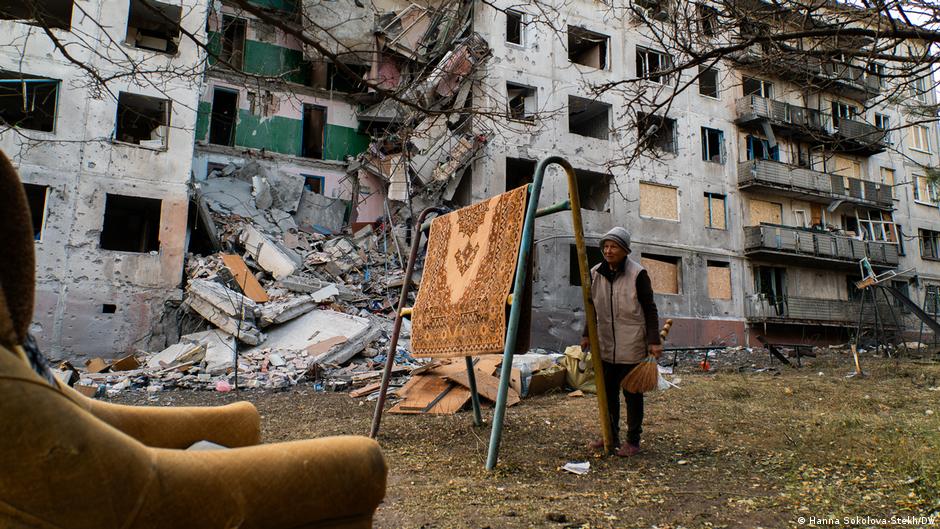
A few days ago, three Russian aerial bombs struck a residential neighborhood on the outskirts of Sloviansk. One hit a five-story apartment building, injuring seven people . Along with neighboring Kramatorsk, Sloviansk is one of the last major towns in the eastern Ukrainian region of Donetsk still under Ukrainian control. Since summer, the city has been a combat zone .
In a courtyard surrounded by damaged apartment blocks, a dusty carpet hangs over the metal frame of a swing set. Tetjana, a pensioner who lives in the building across the street, has brought it out of her rubble-strewn apartment to clean it. She was in her kitchen when the bombs struck.
"The bomb hit the second floor, and a woman who lived on the fourth floor was screaming," she tells DW. "They managed to rescue her before that entire section of the building collapsed," she adds.
Despite being offered the opportunity to evacuate, Tetjana has yet to leave Sloviansk. "I don't know where I would go," she says. Rent can cost up to €400 ($449) a month. Tetjana's pension is the equivalent of just €67 ($75) a month. Even with monthly relocation assistance of about €40 ($45), she could not make ends meet. "I couldn't live on that. Nowhere!"
Meanwhile, electricity and water are still available in her neighborhood, but the gas supply has been cut off. "We'll get through this," Tetjana says hopefully. "Everything will be OK. That's what I tell everyone. I want that so much."
Days after the attack, the few residents remaining in the damaged buildings were still clearing out their apartments. But another attack hit as they worked. This time, the bombs struck a building housing a state-run emergency assistance center and the Red Cross. While firefighters put out the blaze, rescue workers and volunteers retrieved belongings left inside and cleared away broken glass. Eight people were injured in the attack.
"I was on the balcony when there was a deafening bang. It felt as if someone had hit me over the head," says Natalja, describing one of the recent attacks. The pensioner comes to this part of the city to care for her twin sister. "She can no longer get around. Today, I couldn't bring her bread, only crispbread," she tells DW. Although shops and a few stalls remain at the burned-out market, bread is not available every day.
"I tried to persuade my sister to leave. I would go to a nursing home and she would go to a hospital. But her dog is sick, and I have one, too," Natalja says, noting that pets are not allowed during evacuations. "I can't leave my sister behind. She is worried and angry with me, as if everything were my fault. I have no strength left."
Natalja slowly sets off for home, "so I can get there before dark." The city center is nearly 4 kilometers (2.5 miles) away. Public transportation has been suspended since 30 people were killed in an attack on two buses in neighboring Kramatorsk.
The center of Sloviansk is heavily damaged. Few people are out on the streets, though a handful of shops remain open. Of the city's 100,000 residents, about 20,000 remain, most of them elderly people who are unable to leave.
Vasyl, a pensioner, is from the village of Mayaky, north of Sloviansk. A neighbor drove him into the city center, where he sat down for lunch in a cafe. "We're used to living under fire by now," he says. "But it's a bad habit. We should have broken it long ago."
Vasyl wants peace for his homeland. But he rejects Russian President Vladimir Putin's demand that the part of the Donetsk region under Ukrainian control be handed over to Moscow .
Two elderly women talk on a street covered with nets to protect against drones. "I can't remember the last time I slept through the night," says Iryna, a pensioner. "It's terrible, but I have nowhere to go. I'm supposed to leave my two cats behind, but I love them so much. They're all I have."
"We can only hide, trembling, and pray to God that everything will be all right," Iryna continues. "When I have to go to the market, I don't know if I'll make it there alive."
Russian drones attacked the central market several weeks ago, injuring at least three people. Since then, fewer vendors and customers have been coming to the market.
Valeriya sells women's underwear. With kindergartens closed, she has to bring her 5-year-old daughter Sofia to work. Their neighborhood in Sloviansk is not yet subject to the mandatory evacuation of families with children.
"We're used to this life by now. We were evacuated in 2022, but later returned. Now we're waiting to be evacuated again," Valeriya says.
Sofia races through the market aisles with her friend Anya, who is a year older. Anya's mother is a soldier defending her hometown. Her grandmother, Tetjana, sits nearby selling men's clothing. She, too, has to look after her granddaughter while working.
Tetjana has started shipping her belongings to the Dnipropetrovsk region , where she hopes to start a new life. She is sending them while the post office is still open. "It hurts to see our Ukraine being destroyed, " she says, fighting back tears. "Who will rebuild our cities?"
She hopes to return one day. But the fate of Bakhmut weighs on her mind. "Look at Bakhmut. There are no houses left. I'm counting on our boys to hold our cities, even though it's very difficult." Bakhmut, about 50 kilometers (31 miles) from Sloviansk, fell to Russian forces in 2023 after months of heavy fighting.
The women see little hope for a ceasefire. "Putin won't want one. And our younger generation will ask us what we fought for in the first place," Tetjana says. She believes Russia must withdraw from Ukrainian territory.
Drones buzz overhead as gunfire echoes across the market. "It's hard for our boys to shoot them down," Tetjana says. "But they're doing their best."
To view this video please enable JavaScript, and consider upgrading to a web browser that supports HTML5 video