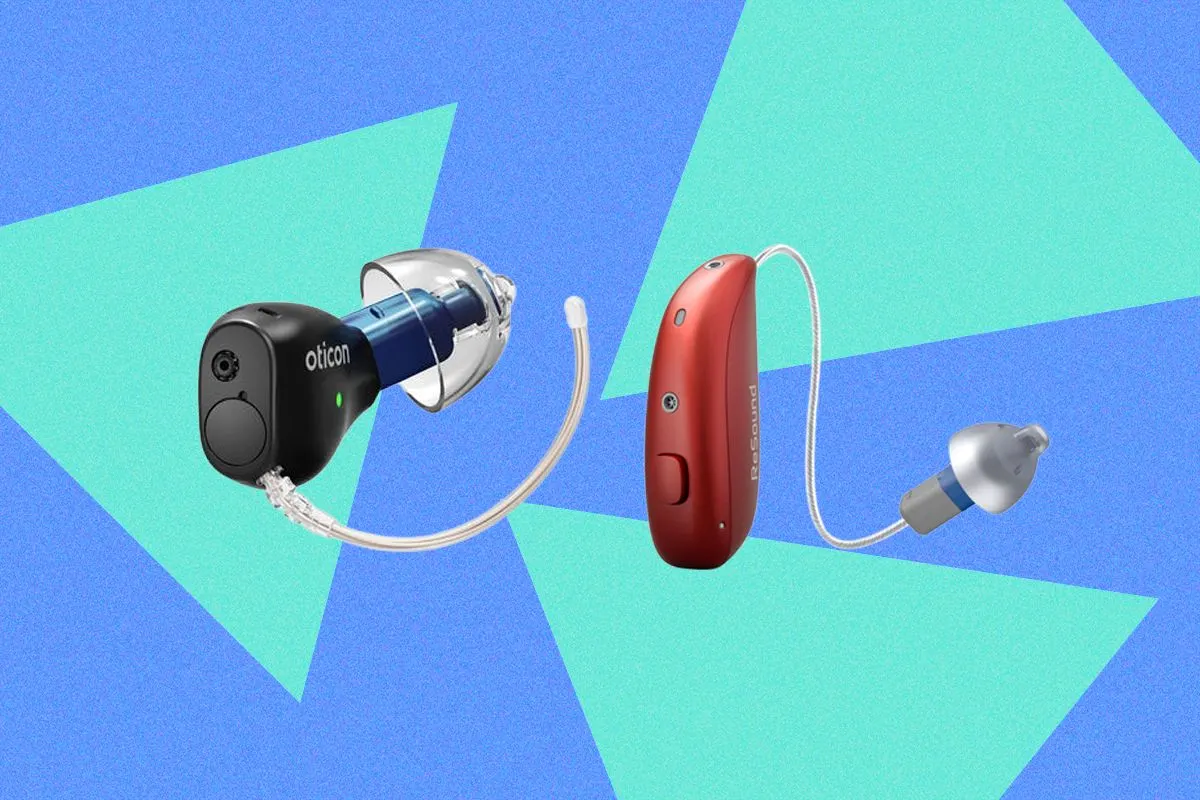
Hearing-challenged individuals have long had one option for dealing with the issue: an expensive, bulky hearing aid prescribed by a doctor. That changed in 2022 when the US Food and Drug Administration approved over-the-counter hearing aid devices , giving consumers access to a vast and growing array of alternatives. Today, there are more hearing aids than ever, and they come in different shapes, sizes, and most importantly, prices. How does a $100 hearing aid compare to a $4,000 prescription device for treating mild to moderate hearing loss? We’ve been testing products for the past four years to answer that question.
I’ve performed hands-on (ears-on?) testing of more than 45 hearing aid models around my home, outside, and in noisy environments. I’ve found plenty to like on the market today—and plenty of aids to avoid. The Jabra Enhance Select 300 holds the crown as the best hearing aid, with the Sony CRE-C20 close behind. Apple’s AirPods Pro 3 deserve special mention too as the easiest way for anyone to get started with hearing aid tech. Here’s our complete roundup of the best prescription and over-the-counter hearing aids we’ve tested and approved.
Updated February 2026: We've added the Oticon Zeal, Phonak Audeo Infinio Ultra Sphere, and Jabra Enhance Select 50R.
Every person is unique, and so are their hearing loss needs. Consider these factors to find a device that suits your needs and lifestyle. For more tips, check out our How to Buy a Hearing Aid guide .
Hearing aids shouldn’t bankrupt you. With such a steep price and minimal insurance coverage , it’s no wonder that so many people put off hearing loss treatment. Between audiologist visits, hearing aid orders, custom fittings, and maintenance, it’s justifiable that you might postpone treatment rather than fork over your credit card. It’s vital you know your budget before you start browsing for hearing aids. Many brands offer trial periods where you can test out the devices for a set number of days and, if they're a bad fit, return them free of charge.
It doesn’t have to be obvious that you’re wearing a hearing aid. Despite cartoonish media depictions of hunched-over seniors screaming “WHAT?!” at every person who tries to talk to them, hearing loss doesn’t discriminate by age. With nearly 10 million Americans under the age of 60 affected, more should be taking advantage of the sleekly designed hearing aids on the market. Similar to the stigmas that keep people from seeking mental health treatment , the hearing-loss community is plagued by self-consciousness when it comes to wearing these devices. Modern in-the-ear (ITE) hearing aids have come a long way in subtlety.
Opt for a professional hearing test over an online one. While online and app-based tests are a good way to dip your toes in and see whether you have hearing loss, a detailed audiogram that only an in-office visit can provide is a far better option. A hearing professional can use this audiogram to calibrate hearing aids to your specific needs.
Before you choose which hearing aid is right for you , it’s best to familiarize yourself with the different styles on the market. While you may see multiple design styles, hearing aids essentially boil down to two main varieties: behind-the-ear and in-the-ear. Completely in-canal (CIC) devices also exist, but none are available over the counter. Here are common terms you’ll see:
Behind-the-ear (BTE) hearing aids , also known as over-the-ear, are probably the most traditional style. For these devices, an often bulky plastic case rests on the back of your ear while a tube delivers sound to an ear mold. Because they’re bigger, they tend to have the most technology and can cater to higher degrees of hearing loss. That said, they also tend to stand out more, which is a drawback for those looking for subtlety. Receiver-in-the-ear (RITE) hearing aids are essentially the same as behind-the-ear devices, with a receiver component that sits in the ear canal instead of being built into the case. Though the industry likes to tout them as a sleeker, less noticeable counterpart, in actuality, they’re not much smaller than BTEs and function identically.
In-the-ear (ITE) hearing aids, also known as in-the-canal (ITC), are more comparable to wireless earbuds from a design standpoint. These devices allow for directional mics but also tend to collect moisture and wax.
Completely in-canal (CIC) hearing aids are the most “invisible” hearing aids on the market. This is because, as the name suggests, they’re completely submerged in your ear canal with nothing sticking out (besides a tiny string for removal). They typically have to be inserted by a professional and left in the ear for longer periods, and as noted, they are not available over the counter.
Traditional hearing aids must be “fitted”—not just physically fitted to your ear anatomy but acoustically fitted to line up with the particulars of your hearing loss. This is because for most people, hearing loss is not unilateral. Some may experience trouble hearing low frequencies, while others may struggle with higher ones. (Mine has a dip somewhere in the middle.) By tuning the hearing aid to boost the frequency bands where your hearing is at its weakest, a precision hearing aid can improve your overall hearing quality without blowing out the frequencies where your ears are already working well.
With self-fitting hearing aids, you do this tuning yourself, at home. Typically, an app will walk you through a simple hearing test, and the results of that test are used to tune, or fit, the frequencies as discussed above. This is basically the same process a doctor will undertake in fitting a prescription hearing aid, only in a simpler and more automated manner.
Conversely, preset hearing aids can’t be tuned in this fashion. These considerably less expensive aids tend to boost all frequencies universally, though most will at least include a slider letting you prefer bass versus treble or vice versa. As a result, the improvement offered by a preset hearing aid will necessarily be less nuanced than that provided by a self-fitted aid, though if you have relatively mild hearing loss, the difference may be less marked than you think.
In the beginning, replaceable (or disposable) batteries were the only option for hearing aids. These batteries are tiny cells, smaller than a pencil eraser, which you replace with a new one after they die. Hearing aid batteries can last for 70 hours or more, so you'd typically replace them once every week or two, depending on use. The longer lifespan means that if you are often away from a power outlet (or forget to charge your aids), you can worry less about running out of juice. (However, you will have to remember to carry spare batteries with you.) Hearing aids with replaceable batteries can also be (but aren’t always) smaller and cheaper, but the batteries are difficult to work with. Even if you have steady hands, it can be difficult to get a tiny battery in and out. These batteries are easy to lose and represent a serious health hazard if children or pets eat them. There’s also a small cost consideration: spare batteries aren’t free.
Rechargeable hearing aids use lithium-ion batteries and recharge via a case, much like standard Bluetooth earbuds. Battery life can vary widely, from over 24 hours to less than eight. That said, for most users, if the case is kept plugged in and the hearing aids are dropped into the case any time they aren’t in use, they should never have to worry about a dead battery. The case itself also has a battery; these can supply an extra three to seven full recharges to the hearing aids before the case batteries die. Again, this varies widely. Rechargeable aids are much more commonplace today and reflect the most up-to-date technology. You’ll have far more options if you go for a rechargeable model.
The Enhance Select 300 from Danish company Jabra are the best hearing aids on the market. With enhanced speech recognition and an excellent customer service network, the Select 300 (9/10, WIRED Recommends) stand out for their ability to match the quality of prescription hearing aids without requiring a prescription. These relatively small behind-the-ear (BTE) devices pair with the Enhance Select mobile app , allowing users to choose between four listening modes—All Around, Restaurant, Music, and Outdoor—though I found the All Around setting to work fine in most environments. Each mode can be customized and lets you further tweak preferences for speech clarity and noise filtering. The Select 300 are Bluetooth-compatible, so you can stream media directly from a smartphone or tablet. And despite the rechargeable case being bulkier than most others on this list, it carries an impressive 72 hours of juice. Fully charged, the aids can last up to 30 hours off a single three-hour charging session.
The Enhance Select 300’s best feature are not what it includes, but what it lacks: hiss. Most hearing aid wearers (myself included) are all too familiar with the unpleasant hiss or static noise that sometimes happens when you increase a hearing aid’s volume beyond about halfway. This model virtually eliminates feedback at even the highest volume levels. But with prescription-level quality comes prescription-level pricing, and at $1,695 a pair, the Enhance Select 300 certainly aren't cheap. You can get financing for as low as $52 per month with a three-year warranty, or wait for a sale, as they often dip to $1,395. You can shave off extra if you opt for the entry-level Enhance Select 50R , but you’ll be sacrificing features like audio quality and the charging case.
Jabra discontinued its excellent Enhance Select 500 and replaced it with the Enhance Select 700 (8/10, WIRED Recommends) . The newer model is extremely familiar, virtually identical to its forebear, with the addition of a new feature designed to improve the way speech sounds in noisy situations and other minor tweaks, such as replaceable covers that shield the microphone ports from dust and grime.
Other than that, the features from the predecessor remain intact here, including support for Bluetooth LE and Auracast and better Android support than the Enhance Select 300. You’ll pay a bit more for it: The Enhance Select 700 is priced the same as the 500 was at launch, which means the more affordable Select 300 is probably still the best bet for most people. (That is, unless you absolutely have to have your hearing aids in red, which is a new color option exclusive to the 700.)
For us to recommend prescription hearing aids—visit a doctor? What is this, 1959?—they have to be good. Like, exceptionally good. Sure enough, the Edge AI RIC RT (8/10, WIRED Recommends) behind-the-ear units from Starkey, a pioneer in hearing aid development, are arguably the most impressive aids we’ve seen to date. They're powered by a processor with an onboard neural processing unit that provides an unabashedly incredible hearing experience. (The chip can also be found in different hearing aid designs from Starkey, including in-the-ear models.)
Once tuned to my audiogram, the lightweight aids gave me the perfect amount of volume and clarity support, even at low volumes. Better yet, they are wholly unencumbered by the static and hiss that is epidemic among cheaper hearing aids. While devices like the Jabra Enhance Select 300 and 500 get close to the quality here, Starkey ultimately has them beat.
But the fun doesn’t stop there, as Starkey has outfitted these hearing aids with a battery that supplies an outstanding 51 hours of life. The carrying case—while not small—provides about three additional charges. The My Starkey app is also extremely easy to navigate. While your audiologist can create multiple environmental listening programs for you, I rarely found much need to switch out of the default program to get an outstanding level of hearing support, regardless of ambient conditions. The app is also loaded with extras, ranging from a fall-detection system to a language transcription function.
The only caveat with the Starkey Edge AI aids is that you’ll have to see a real-life doctor to get them, and that also means you’ll pay considerably more for the privilege. Prices will vary from doc to doc, but at the very least, you will pay more than twice the price for the Edge AI aids than you will for the Jabra 300s. That may be a tough sell, but if you’re at all on the fence, it’s at least worth giving them a test drive.
As with any medical condition, you may not want every person you meet to know that you experience hearing loss. Unfortunately, quality hearing aids are as subtle as a pair of antlers. That’s where in-the-ear (ITE)—also referred to as in-the-canal (ITC)—hearing aids like the Sony CRE-C20 (8/10, WIRED Recommends) come in handy. Developed in conjunction with WS Audiology , the C20s are virtually invisible when worn, with a short retrieval wire hanging out that is noticeable only to someone actively looking for it. They’re also quite comfortable, performance-wise, the C20s offer a crisp sound quality that rivals some competitors charging twice as much.
The C20 aids are an upgrade over our former top pick for this category, the CRE-C10s . The main difference—and almost the only difference—is that the new aids feature a rechargeable battery instead of requiring old-school replaceable ones. The weight of the units remains the same at just 1.34 grams, but battery life impresses at 28 hours per charge. And you can now top them up as often as you want. Sony’s rechargeable E10s offer a bulkier design, and you can still opt for the older C10s, which cost $300 less.
Apple’s 2024 entry to the hearing aid world had an amazing impact on democratizing access to hearing aid technology, and for the last year, I’ve recommended to just about everyone that the best way to get started thinking about hearing health was to pick up a pair of AirPods Pro 2 wireless earbuds . With the arrival of AirPods Pro 3 (9/10, WIRED Recommends) in late 2025, Apple’s improvements to its hearing aid tech may not be the main event, but the upgrades that surround its hearing aid features are more than enough to make this new offering the new king of the hill in the hearing aid/earbuds combo space, especially at this price.
Little has changed with the way hearing improvement works: Take the hearing aid test built into iOS or upload a professional audiogram—you can import your previous settings if you already have a pair of AirPods Pro 2. Hearing aid features are designed for use in Transparency mode, but you can also activate the Media Assist feature to have your hearing aid settings applied to whatever you’re streaming in other listening modes.
While Apple has clearly upgraded the way audio is processed to eliminate the background hiss present in the AirPods Pro 2, that’s possibly less impactful than its improvements to active noise cancellation (ANC), which, as WIRED reviewer Parker Hall notes, is now one of the best on the market. When streaming media with ANC turned on while in a noisy gym, I could barely detect anything happening in the world around me, and with Media Assist active, music never sounded so immersive and alive, even while getting my cardio in. The battery life boost to 8 to 10 hours is also hugely meaningful to hearing aid users. It’s not “all day” battery life, but it’s much better than the 6 hours the AirPods Pro 2 offered.
At $249, the same price as the AirPods Pro 2 at launch, these remain premium-priced for wireless earbuds but are the bargain of the century for hearing aids. While I personally find them a little less comfortable than the AirPods Pro 2, there’s a bigger catch: If you don’t have an iPhone, you’re out of luck.
It’s a little odd to say that EssilorLuxottica’s Nuance Audio Glasses (7/10, WIRED Recommends) are the “best” combination of hearing aid and eyeglasses, because for now, they’re the only option around. Nuance is a groundbreaking device that spins the hearing aid concept completely on its ear (ahem) by embedding microphones up front and speakers directly into the arms of its frames. Nothing goes into your ear at all: The Nuance pipes sound via open-air speakers that work the same way as Ray-Ban Meta glasses , only instead of getting driving directions and playing music, the system is tuned to amplify and clarify ambient sounds.
The Nuance Audio aren’t the most effective hearing aids on the market. The ability to tune them to your specific audiogram is limited, and the open-air design restricts their overall aural capabilities compared to aids that fit tightly in the ear canal. They are also quite heavy—my test model weighed 40 grams—so long-term wear could get uncomfortable. They do, however, solve one of the biggest problems there is with hearing aids: You don’t have to put anything at all in your ears, which means welcome relief from soreness inside the ears, and no discomfort on top of them if you wear both hearing aids and glasses together. Those fixes alone are reason enough for anyone who wears both hearing aids and glasses to give them a serious look. At $1,200 just for the frames, the Nuance Audio Glasses are the most expensive pair of glasses I own. They might also be the best.
JLab has been a player in the earbud space for years, and with the Hear (8/10, WIRED Recommends) , it launches its first hearing aid product—a pair of earbuds that do double duty for both improving your listening experience and streaming media from your mobile device. The earbuds are available in black, white, or beige, and while the 4.94-gram weight of each unit isn’t insignificant, they are reasonably comfortable even for moderate-term wear.
You can’t upload an audiogram to JLab’s app, but four operational modes and additional options like noise cancellation provide a quick way to tune your experience based on your environment. Naturally, the aids particularly shine when it comes to Bluetooth streaming, and they even feature an equalizer that can help you improve things further, though why the noise cancellation feature isn’t available while listening to music is a huge mystery. At this price, though, the Hear over-delivers considerably.
How much money should you expect to spend on a hearing aid? The answer depends primarily on whether you’re looking into over-the-counter or prescription hearing aids. Unsurprisingly, the latter is a wallet guzzler, with average costs between $2,000 to $8,000. But OTCs can ring up quite a tab in their own right, and our most highly rated devices will still run you about $800 to $2,000 a pair. So far, we haven’t found an OTC device under this $800 price that is truly effective at treating hearing loss. In most cases, the $100 budget devices now flooding the market are too good to be true.
Fortunately, there are several methods to manage the high cost of a hearing aid:
Financing is available for virtually all reputable hearing aid companies, so you may not need to pay everything up front. Some plans are offered directly through the company, while others may require a third-party financing company like Klarna or Care Credit .
If you are over the age of 65, you may qualify for an add-on Medicare Advantage Plan (Part C) that may include hearing-related benefits. Most private insurance providers don’t offer hearing exam and device coverage, though some may have the option to add it as a supplemental benefit.
Medicaid coverage in certain states also pays for hearing aids, provided the prescription brand accepts it. Veterans may also qualify for hearing aid coverage through their VA benefits .
Some state governments have programs to help their constituents front the costs of hearing aids. Call or write to your state department to see whether this is a service they offer.
Much like how it does not cover eyeglasses, Medicare does not cover hearing aids. That said, supplemental plans may include hearing benefits: Medicare Advantage Part C plans and many private insurance plans offer some hearing support, but coverage varies widely, so check with your provider before making that appointment. (Many states mandate that private insurance plans cover hearing aids, but a number of these are restricted to coverage for children.) On the plus side, standard Medicare plans (Parts A and B) do cover the cost of a hearing exam, but only with a doctor’s referral.
Many hearing aid providers are now providing financing for their products, usually at very low interest rates that let you pay for the product over up to three years. Medicaid may also help offset the cost of hearing aids, as may employer FSA and HSA plans.
There are two primary ways to buy a hearing aid : through a medical professional (the prescription route) or over-the-counter. Each has its pros and cons.
Prescription hearing aids are usually acquired through an audiologist. These specialists operate businesses ranging from sophisticated medical centers to small shops in a strip mall, usually emblazoned with a sign that reads “HEARING AIDS.” Again, this was the only way to acquire a hearing aid before 2022. An audiologist provides full service for your hearing aid from start to finish. They will test your hearing in a specialized room, physically examine your ears for medical problems, and suggest a hearing aid model. They will tune your chosen hearing aids and adjust them over time if things don’t sound right. The catch? Prescription hearing aids are expensive, anywhere from two to 10 times costlier than over-the-counter models. That said, for consumers who need hand-holding and significant fine-tuning of their hearing aids, professionals like this still have a function.
Over-the-counter aids can be bought through retailers online or offline, just like you would buy, say, a laptop computer. Different vendors offer different levels of presales support, and as the price of an OTC hearing aid goes up, you can usually expect a higher level of service. This may start with an online hearing test delivered to you via your computer or phone; these are not as good as an in-person test, but some can be surprisingly accurate. You may also get access to a remote audiologist who can meet with you over a video chat and fine-tune your hearing aid settings over the air. Ultimately, higher-end OTC aids offer a user experience similar to that of prescription aids, only one that is fully remote. At the low end of the hearing aid spectrum, you may get no service and support at all.
Medically speaking, there are three types of hearing loss. These are:
All of these types of hearing loss can occur due to a variety of factors. Genetics and aging are two of the biggest and most universal: The older you get, the more the sensitive organs inside your ears begin to break down, and this can happen especially early and/or rapidly if you have a family history of hearing loss. The other all-too-common cause for hearing loss is exposure to loud noises, and it doesn’t take much. Many people exposed to prolonged, loud noises like concerts, industrial equipment, motorcycle engines, and sirens experience a gradual hearing loss due to the slow death of tiny hair cells in the inner ear. However, sudden exposure to very loud sounds like explosions and gunshots can cause instantaneous, irreversible damage by rupturing the eardrum (or worse).
There’s no easy way to know which type of hearing loss you have unless you’ve experienced some type of acute damage that has brought on a sudden change in your hearing. Whatever you suspect, it’s important you see a medical doctor to diagnose the issue fully.
Sensorineural is the most common type of hearing loss, and it can be caused by any of the aforementioned issues and more. Sensorineural hearing loss is permanent and can not be reversed, but it can be alleviated through the use of hearing aids. An audiologist can develop an audiogram for you that will show you how severe your he…