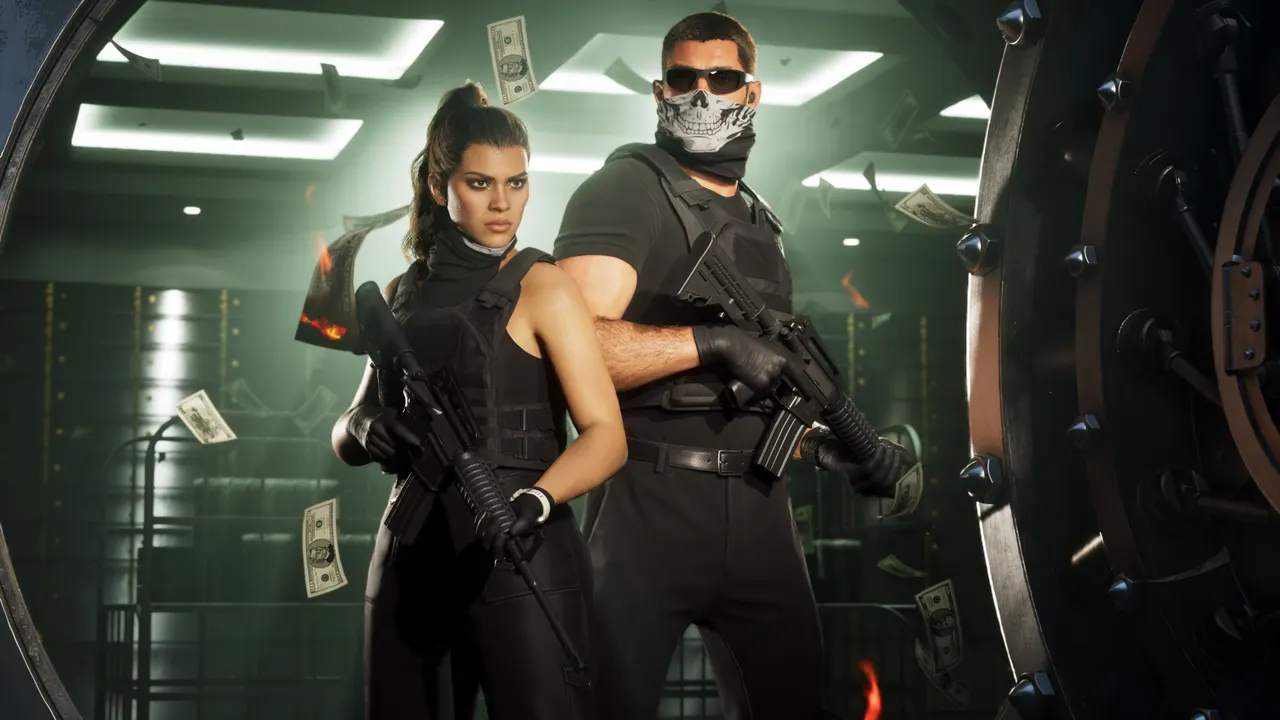
Grand Theft Auto VI finally arrives in November . A staggering 13 years and two console generations after the release of its predecessor , the long-awaited sequel has effectively become one of gaming’s holy grails—a title that some thought they’d never actually see , its development cycle so legendarily long that there’s a dedicated “ we got [x] before GTA 6 ” meme.
The latest criminal opus lets players control Jason and Lucia, a modern-day Bonnie and Clyde, and bears all the hallmarks of Rockstar's incredible attention to detail. Leonida, the open-world setting based on Florida, looks almost impossibly vast yet meticulously detailed, with its own weather systems and hundreds of animal species roaming around.
It’s shaping up to be a game of unprecedented scale and ambition—and exactly the sort of experience the wider industry can’t afford to keep chasing.
At launch, it doesn’t matter how good or bad Grand Theft Auto VI actually is. On sheer hype alone, it’s already guaranteed to be the biggest and most successful entertainment product of the year, maybe the decade. Some estimates already put revenue between $1 billion and $4 billion on preorders alone, with eager players clearly not put off by its $80 price (or $100 for the Ultimate Edition).
Although Rockstar hasn’t confirmed the development budget, that would be a healthy return even on the wildest (and debunked) guess of $2 billion, before factoring long-tail sales or the revenue drawn by the ongoing Grand Theft Auto Online . With numbers like those, it’s easy to understand why every publisher and developer wants their own GTA VI –level game.
Yet even if Grand Theft Auto VI is an outlier, the arms race among AAA-tier developers to constantly deliver bigger, more detailed, more ambitious games is a dangerous direction, hurting both game quality and the people who make them.
The games industry is in a paradoxical crisis. It’s the most successful entertainment medium on Earth—generating $200 billion in revenue in 2025 , dwarfing the global film industry’s $32.8 billion and even beating the combined sports sector's $174 billion —but the last few years have seen seemingly endless developer layoffs , many at headline AAA studios. Worse, many of these redundancies are coming after successful game launches.
Take 2025’s Battlefield 6 as an example. Despite being the top-selling game of the year, shifting 7 million copies in three days after a reported development budget of $400 million , publisher EA fired workers across at least four studios involved in the game's creation. A spokesperson told IGN that the job losses were made to “better align our teams around what matters most to our community” (the CEO got a nice $8 million bonus , though).
It’s far from the only case— Halo: Campaign Evolved developers Halo Studios faced 268 job losses in September 2026, following Xbox announcing 3,200 cuts in July 2026 as part of a wider “reset” across Xbox, while Ubisoft is hitting at least three of its German studios with a round of “voluntary” layoffs , including its Düsseldorf branch that has worked on the likes of Rainbow Six: Siege , which boasts “more than 100 million registered players.” Smaller studios aren't immune—Refactor Games, behind Netflix’s FIFA World Cup game, lost 85 percent of its staff after a “ successful ” launch.
With developers facing unemployment threats even after delivering a financially successful game, unionization efforts are unsurprising, though that's seeing pushback. Rockstar is currently embroiled in a UK tribunal hearing over the alleged dismissal of 34 workers in Edinburgh for union activity. (Rockstar says the workers were dismissed for “sharing confidential company information.”)
Beyond a fraught job market and an unpredictable environment to create games, the AAA sector’s endless pursuit of digital perfection is now arguably delivering weaker, blander games. It’s almost understandable from a financial perspective: If you’ve invested millions of dollars, you want the end product to appeal to the largest possible consumer base to maximize your returns.
However, that same impulse can homogenize the gaming experience. Think of all the big-budget shooters that play identically, or the glossy adventure games that signpost every step with yellow paint so players can’t possibly get lost. Look at the likes of Insomniac’s recent Marvel’s Wolverine —rumored to have a development budget in the hundreds of millions—which launched to solid sales (analyst estimates suggest 1.9 million copies sold in its first three days) but tepid reviews and lukewarm player response, with many critiquing its linear progression and repetitive hack-and-slash gameplay.
The bigger games have gotten, the more time they demand from players too, and rarely in meaningful ways. Open-world games in particular feel increasingly crammed with time-eating diversions— Assassin’s Creed Valhalla notoriously needed 150-plus hours to see everything its accurately crafted bleak medieval English settlements had to offer. But much of it felt like busywork to showcase Ubisoft’s investment in creating such realistic environments.
Such virtual spaces are often impressive, yes, but will Grand Theft Auto VI be better with a world map reportedly three times larger than the already colossal Red Dead Redemption 2 ? Is it worth building something of that size if players don’t have time to experience most of it?
The solution to runaway costs, developer security, and the limited time players have to sink into games should be clear: aim smaller.
That’s not to say the entire industry should pivot toward indie-level games (though there are some absolute greats in that area ), but rather that publishers should refocus on games that can still showcase their creators’ talents and offer satisfying but digestible experiences to players, without pouring dangerous sums of money into ever bigger, ever riskier titles. In short, rediscover the “AA”-scale game.
The textbook example of how successful this can be is Clair Obscur: Expedition 33 . The debut game from French developer Sandfall Interactive appeared practically out of nowhere in April 2025, and exploded. The RPG earned rapturous reviews and endless fan acclaim, celebrated for its challenging dodge-and-parry twist on turn-based combat, its stunning world—a breathtaking blend of belle epoque and dark fantasy imagery, wrapped in a gorgeous painterly flourish—and its mature and emotionally complex story of explorers battling the inevitability of death.
In technology and production quality terms, it’s no slouch for a “smaller” game, either. Clair Obscur has motion-capture performances, a voice cast featuring Hollywood heavyweights like Charlie Cox and Andy Serkis, a full orchestral score, and dazzling visuals. It even packs a solid 60-odd hours of playtime, making it feel significant and not daunting. It ultimately swept up over 500 Game of the Year Awards and went on to sell 8 million copies as of April 2026.
While that number pales in comparison to Battlefield 6’s 7 million units in mere days, Clair Obscur did it all on a budget of less than $10 million , and with a tiny development staff. The game was hugely successful for its budget, letting the studio continue without resorting to painful layoffs. Sandfall’s success isn’t a one-off. Look at Supergiant Games’ Hades duology, AdHoc Studio’s Dispatch , or Mintrocket’s Dave the Diver for more evidence that studios and labels should focus on smaller but richer gaming experiences.
Another major benefit of aiming smaller is that it lets companies mitigate rising development costs for themselves and consumers. The memory crisis is forcibly extending the hardware life cycle, delaying new console generations and blocking supplies of powerful PC graphics cards, leaving many players without the means to reap the benefits of the most demanding games.
As Final Fantasy VII Revelation director Naoki Hamaguchi —no stranger to hugely ambitious games with incredibly long development cycles—says, “There isn't a single console that you can say, ‘As long as I have this, I'll be able to play everything, to do everything.’ Personally, I think that over the course of the next 10 years, if someone said, ‘Here's the next generation of consoles,’ the market and the audience are not necessarily going to just jump over.”
Hamaguchi says the industry will still straddle the lower-spec options, like a Steam Deck or Nintendo Switch 2 , providing broader experiences to a wider base. It won't be so much about cutting-edge technology, but how developers can compete in game design. "I think we're going to be entering an age where that's really the focus of competition,” he says.
Sadly, this approach has one big problem: Developers are already trying it but failing to draw investment . There’s no easy answer—investors follow the money, and the money points to GTA -scale games, even though AAA development increasingly leaves carnage in its wake.
Even Rockstar appears to realize the current approach is unsustainable, with studio veteran Phil Hooker telling Bloomberg that “the engine, the tools, and the team we've built during the [ GTA VI ] project will allow us to do things more quickly” in the future. Hopefully, good news for fans who fear another decade-long wait for GTA VII .
Grand Theft Auto VI will be a success, and its longevity is already certain. But when every other publisher sees the inevitable slate of sales records the game will shatter, they’d do well to think twice before chasing it—the games industry might not survive if they do.