Wall Street's fear gauge, the VIX index, ripped higher on Friday as stocks tanked on AI and geopolitical worries. Bitcoin BTC $81,115.77 traded choppy.
However, if VIX history and bitcoin’s steady weekend price action are any guide, the panic could subside just as quickly on Monday.
First, a quick primer. Cboe’s VIX measures how much traders expect the S&P 500, the blue-chip stock index, to swing over the next four weeks. It's derived from options prices. When people get nervous, they buy options, which are contracts used to hedge against price swings. That pushes the VIX up.
Bitcoin BTC $81,115.77 , meanwhile, is the only macro asset thats trades over the weekend. As such, swings in bitcoin over the weekend are often seen as lead indicators of how traditional markets may open on Monday.
On Friday, the VIX jumped 21.5% to 19.99 as the S&P 500 fell by 1.09%.
That's VIX’s biggest one-day rise since June 5, when the S&P 500 suffered its worst day in months, according to data source TradingView.
Traders are betting the VIX stays high through November. CNBC reports that traders bought 9,200 of the Nov. 18, 20-strike calls for $1.7 million. Traders also bought 12,500 of the Nov. 18, 23-strike calls for $1.1 million. The bet is that the VIX closes above 23 by the third week of November.
That sentiment is consistent with the present macro developments. AI stocks have been hit hard in the week gone by. The cost of default insurance on AI-related firms has hit record highs . Geopolitics is pushing oil higher too. On Saturday, Iran's Revolutionary Guards said two oil tankers caught fire after hitting mines in the Strait of Hormuz. The Russia-Ukraine front looks like it's heating up as well.
Big Friday jumps in the VIX usually don't last, according to historical data.
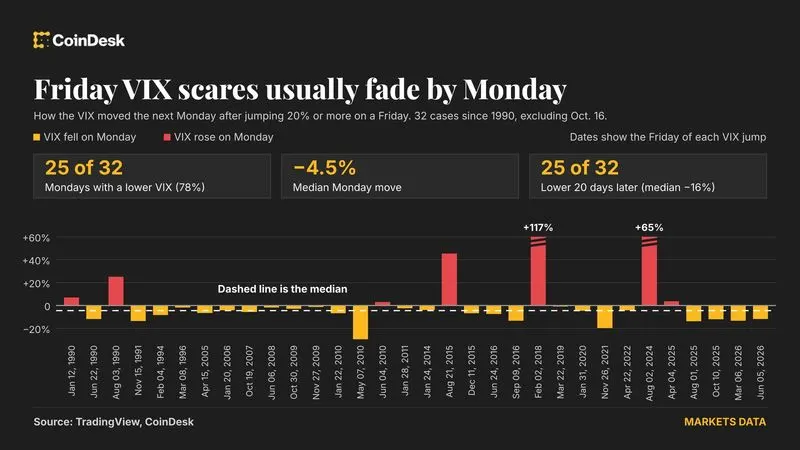
CoinDesk's analysis of the data finds the VIX has jumped 20% or more on a Friday 32 times since January 1990, not counting the latest one. The next Monday, it fell 25 times and rose just seven.
In other words, investors slept over the Friday panic over the weekend and things normalized on Monday. The typical Monday move was a drop of 4.5%. A month later, the VIX was lower in 25 of the 32 cases, and the median drop was 16%.
Seasonality also favors the VIX bears, and by extension stock market stability.
The VIX has declined in November in 25 of the last 36 years, with a median drop of 7.2%. From October end to the end of the year, VIX has fallen in 22 of 36 years, with a median decline of 9.4%.
Bitcoin isn’t flinching. It continues to trade above $80,000, comfortably within its recent choppy range, suggesting Friday’s risk aversion and VIX rise may not carry into Monday.
The bitcoin market has been more active over the weekend this year , especially on Sunday, as geopolitical flareups that began in early March keep investors on edge. That activity highlights bitcoin’s role as a always-on macro asset: When traditional markets are shut, traders use bitcoin to express their early read on global risk appetite.
Volmex's BVIV, the bitcoin volatility index, or the bitcoin VIX, slipped 1% on Friday to just under 40% and has barely moved since. BVIV shows the 30-day implied or expected volatility in bitcoin.
Bettors on the decentralized platform Polymarket aren't panicking either . They see just an 9% chance the AI bubble bursts this year as of this writing.
None of the above guarantees a stable Monday. Moreover, in seven of the 32 cases, the VIX kept climbing sharply on Monday, including in August 2015, February 2018 and August 2024.
Going purely by the VIX levels, there's room for the index to run.
Even after Friday’s spike, the VIX is still under 20, a mark it has topped on more than a third of days since 1990. It has closed above 30 on just 8% of days. So, if fear grips the market further on Monday morning, the VIX can climb.
Diversified RWA stablecoins sustain 5-7% yield from real credit as crypto funding compresses to ~4%. GENIUS pushes yield off-chain; TAM grows to $4B in 3 years.