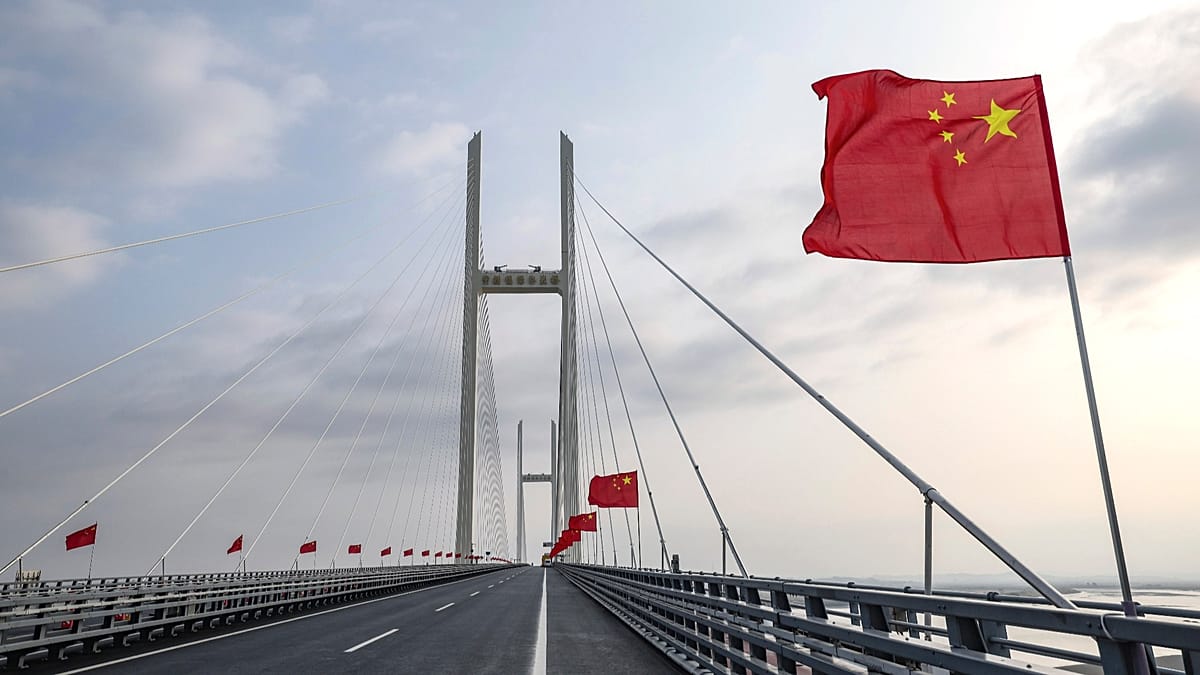
A new four-lane road bridge linking China and North Korea finally opened on Thursday, 12 years late, enabling the Asian giant and its isolated nuclear-armed neighbour to substantially step up cross-border trade.
China is North Korea's largest trading partner and a vital diplomatic and political backer, although relations have not always been smooth with the ruling Kim dynasty.
Hundreds of people gathered on Thursday in the northern Chinese border town of Dandong, taking selfies in front of the 3,026-metre New Yalu River vehicle bridge before it opened.
Trucks bearing the nations' flags began moving in both directions late in the morning, with some of the North Korean vehicles decorated with flowers.
"It's great," one woman who came to watch told the AFP news agency in the town dotted with Chinese as well as Korean shops and restaurants, where residents were relieved the bridge had finally open.
"It's already been over 10 years. It's certainly going to be good for business," she said, without wishing to be named, accompanied by her friend and her dog.
"I hope the standard of living in North Korea can rise to the level we have here," Dandong local Yu Shuyan, who before the pandemic had visited North Korea, said.
Chinese Premier Li Qiang said that the bridge symbolised Beijing's friendship with Pyongyang and that relations were "entering a new stage and opening a new chapter".
"Thanks to the joint efforts of both sides, the successful opening of the bridge will not only strongly boost economic and trade cooperation between the two countries, but will also further facilitate people-to-people exchanges and tighten the bonds of affection between the two peoples," Li said by video link at the opening ceremony, China’s Xinhua news agency reported.
The structure was completed in 2014 but its opening was delayed due to a lack of connecting roads and customs facilities on the North Korean side, South Korea's Yonhap news agency reported.
North Korea also sealed its borders during the COVID-19 pandemic and train journeys between the East Asian neighbours only restarted in March after a six-year halt.
The new bridge is not the only border crossing between the two countries.
But the new structure will supersede the "extremely narrow" rail-and-road Sino-Korean Friendship Bridge downstream on the Yalu River, said Lim Eul-chul, a North Korea expert at Kyungnam University.
"Previously, transporting heavy cargo such as industrial machinery, raw materials, construction materials and energy-related supplies required extreme caution because of safety concerns surrounding the ageing bridge," Lim told AFP.
"The new crossing will make such shipments much easier and more efficient," he said, calling it a "groundbreaking development" that will substantially increase cargo traffic.
The new bridge's launch came about a month after North Korea and Russia opened a road bridge as part of their efforts to cement relations.
Experts say Chinese officials likely felt uneasy about its opening.
China has long been North Korea’s biggest trading partner and economic pipeline. But in recent years, North Korean leader Kim Jong-un has prioritised Moscow, sending thousands of troops and conventional weapons to support Russian President Vladimir Putin’s war in Ukraine, apparently in exchange for military and economic assistance.
But Kim has recently drawn closer to China with the apparent intent to improve his country's economy and build a front against the United States.
China, for its part, wants to restore its unique influence over North Korea. Last year, about 98% of North Korea’s external trade was with China.
North Korea has not yet resumed issuing tourism visas to Chinese citizens, who once made up the bulk of its overseas visitors.
South Korea's unification ministry said that Seoul is "closely monitoring" the situation regarding the new bridge.