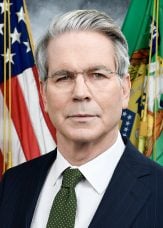
The Treasury Secretary told a closed-door audience that dire warnings from AI leaders read more like alarm than useful guidance
US Treasury Secretary Scott Bessent has a message for anyone losing sleep over artificial intelligence: the risk is not systemic, and the industry can handle its own problems.
Speaking at a closed-door investor conference on October 21, 2026, Bessent dismissed concerns about ‘systemic’ AI risks. He treated existential warnings from prominent AI figures as alarmist rather than constructive.
He has pushed back on a specific combination of requests from parts of the industry. Some AI leaders have called for a slowdown in development while also seeking liability protections. Bessent has been skeptical of that pairing.
Bessent has said AI firms could halt operations whenever they choose, which keeps responsibility squarely on their own shoulders.
Bessent’s stance favors self-regulation. He wants the AI industry to take ownership of its risks rather than lean on government interventions such as liability shields.
On September 15, 2026, he testified before Congress on AI regulation. During that testimony, he said he had not yet seen a regulation he could support.
Daily. Free. Join 34,000+ readers across crypto, finance, and policy.
In early October, he carried similar themes into interviews with Axios and CNBC. There, he again questioned the case for AI slowdowns bundled with requests for liability protections.
Bessent has initiated discussions between the US and China on AI incident notifications. Those talks are aimed at risks tied to cyberattacks, uncontrolled agents and other dangers.
When the person overseeing the financial system says a technology does not pose systemic danger, that sends a signal. It tells investors the government is not preparing a heavy regulatory response anytime soon.
Several high-profile figures in the field have warned about existential threats from their own creations. Bessent’s response, in effect, is that those warnings are unhelpful and that the builders should own the consequences.
A Treasury Secretary who has not found an AI rule he can back is unlikely to champion sweeping new restrictions. Bessent’s refusal to support liability shields means AI firms may carry more legal exposure for what their products do. Companies hoping for a safe harbor in exchange for slowing down should not expect one from this Treasury.
The US-China talks are worth watching closely. Agreements on AI incident notifications would give both governments a channel to flag cyberattacks or runaway systems quickly.